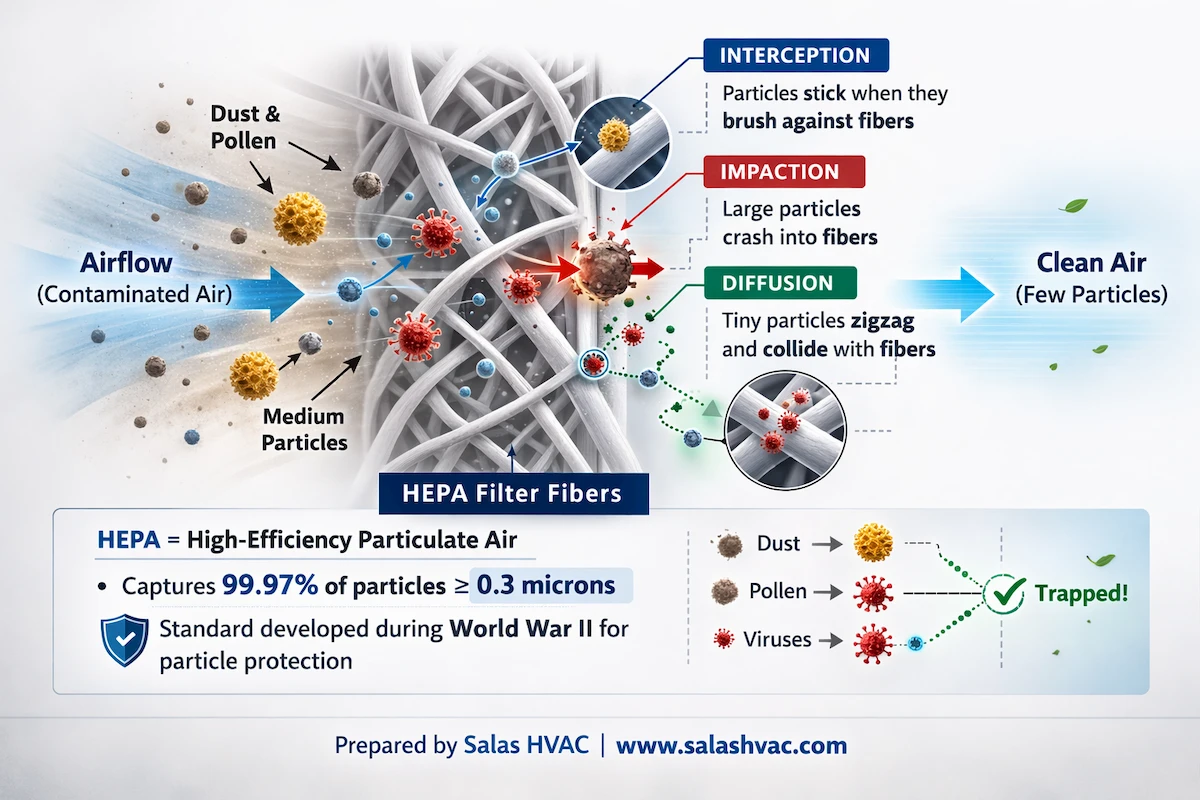
HEPA filters promise to capture 99.97% of airborne particles, but do HEPA filters remove viruses effectively? While HEPA filters can trap particles as small as 0.3 microns, viruses measure between 0.02-0.3 microns.
This size discrepancy makes people question whether HEPA filtration actually protects against airborne viruses like influenza and COVID-19. The answer involves physics that some air purifier companies conveniently leave out of their marketing.
How HEPA Filters Capture Airborne Particles
HEPA stands for High-Efficiency Particulate Air.
True HEPA filters must capture 99.97% of particles measuring 0.3 microns in diameter. This standard was developed during World War II to protect workers from radioactive particles.
HEPA filters use three mechanical processes to trap particles:
- Interception: Particles stick to filter fibers when they brush against them
- Impaction: Larger particles crash into fibers and embed themselves
- Diffusion: Tiny particles zigzag through air molecules and collide with fibers
These physical mechanisms work together to remove contaminants without producing ozone or chemical byproducts.
Unlike ionizer air purifiers, HEPA filtration actually removes particles from your air rather than just displacing them.
Virus Sizes vs. HEPA Filter Capabilities
Individual virus particles are incredibly small. The influenza virus measures roughly 0.08 to 0.12 microns. SARS-CoV-2 particles are even smaller at less than 0.1 microns.
This raises an obvious question: if HEPA filters target 0.3-micron particles, how can they catch smaller viruses?
The answer lies in how viruses travel. Viruses rarely float through air alone. They hitch rides on larger respiratory droplets ranging from 0.5 to 9.3 microns in size.
Research published in the International Journal of Environmental Research and Public Health found that SARS-CoV-2 travels on droplets averaging 9.3 microns in diameter.
These droplet sizes fall well within HEPA filtration range.
When an infected person exhales, coughs, or sneezes, virus-laden droplets enter your air. HEPA filters capture these droplets, removing the viruses they carry.
Do HEPA Filters Actually Remove Viruses?
Multiple studies confirm that HEPA filters reduce airborne viral concentrations. Research published in Otolaryngology-Head and Neck Surgery demonstrated that air purifiers with HEPA filters markedly reduce SARS-CoV-2 viral particles in the air.
Healthcare facilities worldwide rely on HEPA filtration to control infection. The NHS and WHO trust medical-grade HEPA systems to protect patients and staff in high-risk environments. These real-world applications prove the technology works when implemented correctly.
However, a comprehensive review published in Preventive Medicine analyzed 32 studies and found no solid evidence that HEPA air purifiers reduce actual respiratory infection rates in real-world settings.
This distinction matters: HEPA filters remove viral particles from air, but they cannot guarantee you will not get sick.
Why HEPA Filters Cannot Guarantee Virus Protection
Several factors limit HEPA effectiveness against illness:
1. Filter Sizing and Room Coverage
A small HEPA unit cannot clean a large room effectively. The Clean Air Delivery Rate (CADR) indicates how quickly a purifier filters air. Higher CADR ratings mean faster purification. Match your unit size to your room dimensions for optimal performance.
2. Placement and Air Circulation
Proper placement significantly impacts effectiveness. Units placed against walls or blocked by furniture cannot circulate air properly. Position your purifier centrally with clear airflow paths.
3. Individual Susceptibility
Some people face higher infection risks due to immune status, exposure levels, or underlying conditions. HEPA filtration reduces airborne viral load but cannot eliminate all exposure pathways.
4. Surface and Contact Transmission
Viruses spread through contaminated surfaces and direct contact. HEPA filters only address airborne transmission. You still need hand washing, surface cleaning, and other hygiene practices.
HEPA Filter Maintenance for Maximum Virus Protection
A clogged or old HEPA filter loses efficiency quickly. Regular maintenance ensures your system continues removing viral particles effectively.
Follow these guidelines:
- Check filter condition monthly
- Replace filters per manufacturer recommendations (typically 6-12 months)
- Monitor filter life indicators if your unit has them
- Keep pre-filters clean to extend HEPA filter life
Neglecting maintenance allows particles to bypass the filter or restricts airflow, reducing purification capacity. Set calendar reminders to inspect and replace filters on schedule.
Combining HEPA with Other Air Cleaning Technologies
Standalone HEPA filters capture particles but do not neutralize viruses. Some advanced systems combine HEPA with additional technologies:
UV-C Light
Ultraviolet light destroys viral DNA and RNA, rendering pathogens inactive. UV-C systems installed in HVAC ductwork or within portable units add a second layer of protection. However, UV exposure must occur for sufficient time to damage viral genetic material.
Activated Carbon
Carbon filters adsorb gases, odors, and volatile organic compounds. While they do not capture viruses directly, they improve overall air quality and remove chemical pollutants that HEPA filters cannot touch.
Bipolar Ionization
Some systems add ionization to charge particles, making them easier for HEPA filters to capture. Research from Aerosol and Air Quality Research shows that unipolar ionizers can enhance particle wall deposition by a factor of two, potentially boosting overall system effectiveness.
Choosing the Right HEPA System for Virus Protection
Not all HEPA filters are created equal. Look for these features when selecting a system:
| Feature | Our Recommendation |
| Filter grade | True HEPA (H13 or H14 for medical-grade) |
| CADR rating | Match to room size (higher is better) |
| Room coverage | Rated for your specific square footage |
| Additional stages | Pre-filter and activated carbon recommended |
| Certification | AHAM Verifide or equivalent testing |
Avoid “HEPA-type” or “HEPA-like” filters. These terms indicate lower efficiency standards.
Only true HEPA filters meet the 99.97% at 0.3 microns requirement.
FAQs
Do HEPA filters kill viruses?
No. HEPA filters capture and trap viruses but do not kill them. The viruses remain in the filter media until you dispose of it. Some systems add UV-C light to neutralize captured pathogens.
Can HEPA filters prevent COVID-19?
HEPA filters reduce airborne SARS-CoV-2 particles but cannot guarantee prevention. They are one tool among many, including vaccination, masking, and ventilation. No single measure provides complete protection.
How often should I replace HEPA filters for virus protection?
Replace HEPA filters every 6-12 months depending on usage and air quality. High-traffic areas or homes with sick occupants may need more frequent changes. Follow manufacturer guidelines and monitor filter condition.
Are portable HEPA units effective or do I need whole-house filtration?
Portable units work well for single rooms. For whole-home protection, consider upgrading your HVAC with HEPA filtration or installing a whole-house air purifier. Both approaches have merits depending on your needs and budget.
Do HEPA filters work better than ionizers for viruses?
Yes. HEPA filters physically remove viral particles from air. Ionizer air purifiers only charge particles, causing them to settle on surfaces where they can be disturbed and re-aerosolized. HEPA provides more reliable virus removal.
The Bottom Line: Should You Trust HEPA for Virus Protection?
HEPA filters effectively remove airborne viral particles when sized, placed, and maintained correctly. They capture virus-laden respiratory droplets that would otherwise circulate through your home. However, they are not a magic shield against illness.
For comprehensive protection, combine HEPA filtration with:
- Proper ventilation and outdoor air exchange
- Regular surface cleaning and disinfection
- Hand hygiene practices
- Appropriate vaccination
At Salas HVAC, we help homeowners and businesses select, install and maintain air quality systems that fit their specific needs. If you are considering adding air purification, we can assess your home and recommend proven solutions. HEPA technology works, but only as part of a broader healthy home strategy.
Breathe easy,
Michael
Sources
Aerosol and Air Quality Research. “Effect of Ionizers on Indoor Air Quality and Performance of Air Cleaning Systems.” December 2023.
https://aaqr.org/articles/aaqr-23-10-oa-0240
International Journal of Environmental Research and Public Health. Minimum Sizes of Respiratory Particles Carrying SARS-CoV-2 and the Possibility of Aerosol Generation. September 2020.
https://pmc.ncbi.nlm.nih.gov/articles/PMC7579175/
Otolaryngology-Head and Neck Surgery. HEPA filter SARS-CoV-2 reduction study. June 2021.
https://aao-hnsfjournals.onlinelibrary.wiley.com/doi/full/10.1177/01945998211022636