Air purifier statistics tell a clear story in 2026. More people worry about the air inside their homes than ever before, and they put real money behind that worry.
Wildfire smoke seasons grow longer. Allergy rates keep climbing. And research keeps proving that indoor air deserves as much attention as outdoor air.
Read on to find the latest air purifier market size data, adoption trends, and performance numbers.
Air Purifier Market Size at a Glance (2026)
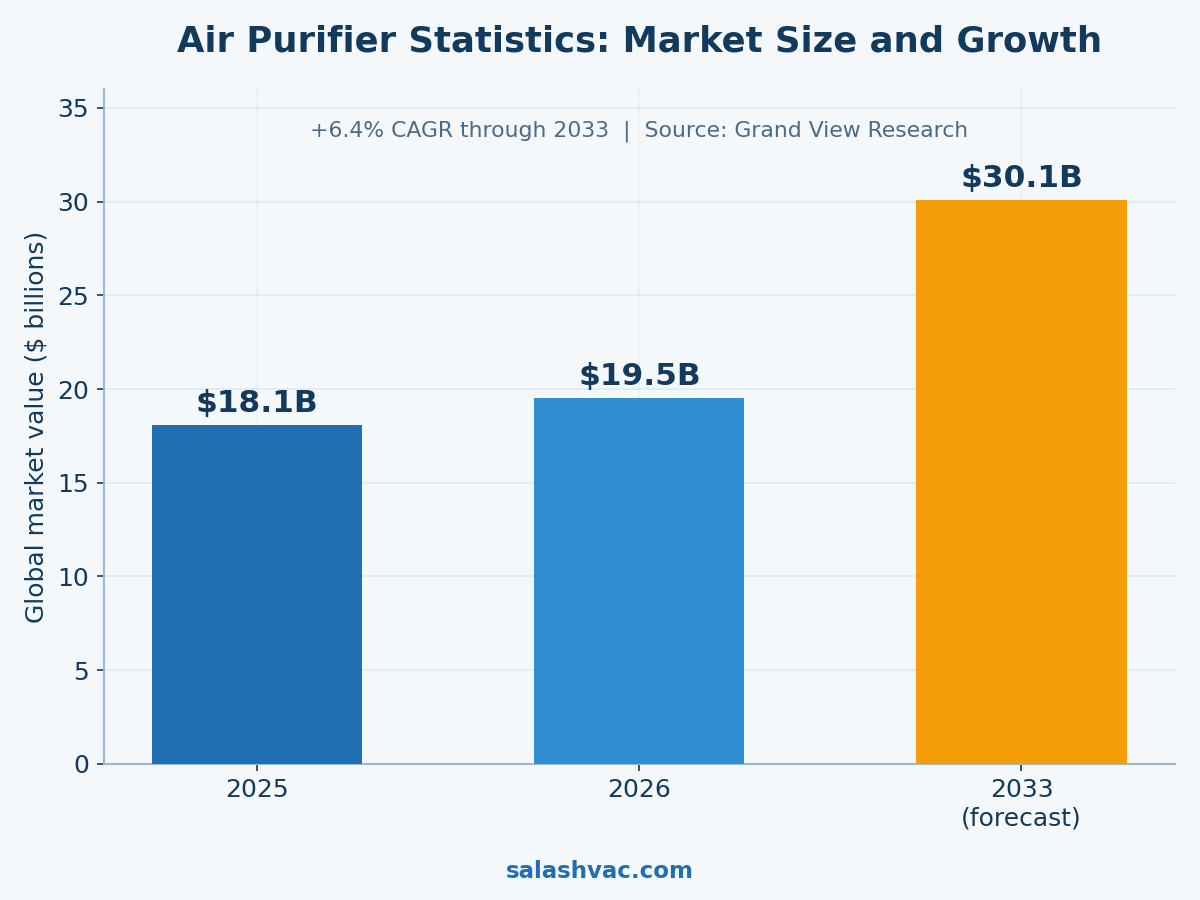
The global air purifier market is worth an estimated $19.5 billion in 2026.
It grew from $18.1 billion in 2025 and analysts project it will reach $30.1 billion by 2033. That equals a compound annual growth rate (CAGR) of 6.4%.
Here are the key numbers you need to know:
| Metric | Value |
|---|---|
| Global market size 2025 | $18.1 billion |
| Global market estimate 2026 | $19.5 billion |
| Global market forecast 2033 | $30.1 billion |
| Global CAGR (2026 to 2033) | 6.4% |
| U.S. market size 2025 | $4.73 billion |
| U.S. market forecast 2033 | $7.92 billion |
| U.S. CAGR (2026 to 2033) | 6.8% |
A second research by Fortune Business Insights values the market nearly identically. They put the 2025 global market at $18.28 billion and project $32.72 billion by 2034 at a 6.68% CAGR.
When two independent research houses land within 1% of each other, you can trust the trend line. The air purifier market grows steadily, not explosively.
Global Air Purifier Market Growth Statistics
Growth is not spread evenly around the world. A few regions and segments pull most of the weight.
Asia Pacific leads the global market with 39.7% of all revenue in 2025.
China holds the largest single country share. Rapid urbanization and severe city pollution drive most of that demand (Source: grandviewresearch.com).
Portable and standalone units dominate everywhere. They accounted for 66.9% of global revenue in 2025 because they need no installation and move easily from room to room (Source: grandviewresearch.com).
The portable segment alone was worth $12.8 billion in 2025. Analysts expect it to hit $22.1 billion by 2033 (Source: grandviewresearch.com).
Offline retail still leads with 57.2% of sales in 2025, but online sales grow fastest. Shoppers research specs online, and smart features push them toward e-commerce (Source: grandviewresearch.com).
Indoor vs Outdoor Air: The Exposure Statistics
Air purifier sales only make sense when you see the exposure data behind them. These three numbers explain most of the demand.
Americans spend about 90% of their time indoors. The people most vulnerable to pollution, including young children, older adults, and anyone with heart or lung disease, spend even more time inside (Source: epa.gov).
Concentrations of some pollutants run 2 to 5 times higher indoors than outdoors. During activities like cooking or cleaning, indoor levels can occasionally spike to more than 100 times outdoor levels (Source: epa.gov).
The EPA ranks indoor air pollution among the top five environmental risks to public health. Indoor pollutant levels can reach up to 100 times outdoor levels in some buildings (Source: pmc.ncbi.nlm.nih.gov).
Here is why this matters. Modern homes seal tighter than older ones. Energy efficient construction traps pollutants inside when ventilation cannot keep up. Synthetic materials, cleaners, and furnishings add more sources every year.
You breathe roughly 2,000 gallons of air every day. That is enough to fill a small swimming pool (Source: asthmaandallergyfriendly.com).
U.S. Air Purifier Market Statistics
The U.S. market punches well above its weight. It was worth $4.73 billion in 2025 and should reach $7.92 billion by 2033, growing at 6.8% per year (Source: grandviewresearch.com).
California alone accounts for 11.6% of the entire U.S. market. High pollution levels and repeated wildfire seasons explain that outsized share (Source: grandviewresearch.com).
Why do Americans buy so many purifiers? The air quality data answers that question:
- 46% of Americans (over 156 million people) live in areas with unhealthy ozone or particle pollution. That is the highest figure in a decade (Source: asthmaandallergyfriendly.com).
- 25.2% of U.S. adults had diagnosed seasonal allergies in 2024. This group forms a huge base of buyers sensitive to pollen and dust (Source: marknteladvisors.com).
- Americans spend about 90% of their time indoors, where some pollutant concentrations run 2 to 5 times higher than outdoors (Source: epa.gov).
Our indoor air quality statistics roundup digs deeper into what that indoor exposure means for your health.
Which Air Purifier Technologies Lead the Market?
Not all purifiers sell equally. The technology split shows what buyers trust.
HEPA filters hold the largest technology share at 41.7% of global revenue in 2025. Activated carbon follows as the fastest growing technology at a 7.6% CAGR through 2033 (Source: grandviewresearch.com).
This matters because HEPA has a strict legal definition. A true HEPA filter must capture at least 99.97% of particles at 0.3 microns, the hardest particle size to trap. The U.S. Department of Energy set that standard (Source: epa.gov).
Room size coverage also shapes buying patterns. Units rated for 250 to 400 square feet took 39.4% of the market in 2025. That range fits most bedrooms and living rooms. Compact units under 250 square feet grow fastest at 7.2% CAGR (Source: grandviewresearch.com).
If you wonder which size fits your rooms, our expert guide on where to place your air purifier walks through the decision step by step.
Smart Features and Online Sales: The New Buying Trends
Two shifts reshape how people buy air purifiers in 2026.
First, purifiers got smart. Manufacturers now ship units with app control, real time air quality monitoring, and voice assistant support. IoT integration makes these devices fit naturally into connected homes and offices (Source: grandviewresearch.com).
Second, buying moved online. Offline retail still leads with 57.2% of sales, but online is the fastest growing channel. Shoppers compare specs, read reviews, and order direct (Source: grandviewresearch.com).
Sustainability trends matter too. Brands now compete on energy efficient designs, recyclable filters, and lower noise levels. Buyers reward quieter, cheaper-to-run units (Source: Portable Air Purifier Market Size & Share Report, Grand View Research, 2026, grandviewresearch.com).
What does this mean for you? Expect better features at lower prices each year. Competition in a growing market works in your favor.
One buying tip falls out of the data. Stick with units that publish a verified HEPA spec and a clear room size rating. Those two numbers, 99.97% at 0.3 microns and a square footage that matches your room, matter more than any smart feature (Source: grandviewresearch.com).
Do Air Purifier Statistics Prove They Actually Work?
Market size only tells you people buy purifiers. Performance data tells you whether buyers get results.
The lab numbers are strong. A certified HEPA filter removes at least 99.97% of airborne particles at the 0.3 micron test size, and it captures larger and smaller particles at even higher rates (Source: epa.gov).
The health context makes those numbers matter. The EPA ranks indoor air pollution among the top five environmental risks to public health. Indoor pollutant levels can occasionally exceed outdoor levels by more than 100 times (Source: pmc.ncbi.nlm.nih.gov).
Clean air also pays off at work. Improving indoor air quality by lowering VOCs and raising ventilation boosted cognitive performance by as much as 61% in office testing (Source: asthmaandallergyfriendly.com).
Still on the fence about buying one? Our honest breakdown of whether you need an air purifier helps you decide based on your situation, not hype.
What These Air Purifier Statistics Mean for You
Three takeaways stand out from the 2026 data.
First, this is a mature, stable market. A 6.4% to 6.8% growth rate signals steady demand, not a fad. Manufacturers keep investing because buyers keep coming back.
Second, the technology has a clear winner. HEPA filtration leads because it meets a verifiable federal standard. When you shop, that 99.97% at 0.3 microns spec is the number to check.
Third, the health case keeps getting stronger. Between EPA exposure data, rising allergy rates, and worse wildfire seasons, the reasons to own a purifier grow each year.
Budget plays a role too. If price is your next question, see our breakdown of how much an air purifier costs across every category, from budget units to whole home systems.
And if odors are your main complaint, our guide on whether air purifiers help with bad smells explains which filter types handle odors and which do not.
Breathe well,
James Mahoney
Co-Owner, Salas HVAC
FAQs
How big is the air purifier market in 2026?
The global air purifier market is worth an estimated $19.5 billion in 2026. Analysts project growth to $30.1 billion by 2033 at a 6.4% CAGR. The U.S. market alone was worth $4.73 billion in 2025.
What percentage of Americans need cleaner indoor air?
About 46% of Americans, over 156 million people, live in areas with unhealthy ozone or particle pollution. Since Americans spend roughly 90% of their time indoors, indoor air cleaning affects nearly everyone.
Which air purifier technology sells the most?
HEPA filtration leads with 41.7% of global market revenue in 2025. Buyers trust it because the U.S. Department of Energy standard requires 99.97% particle removal at 0.3 microns.
What size air purifier do most people buy?
Units rated for 250 to 400 square feet lead with 39.4% of the market. That range covers most bedrooms and living rooms. Compact units under 250 square feet grow fastest at 7.2% CAGR.
Are air purifier sales growing or declining?
Sales are growing steadily. The global market grows at about 6.4% per year and the U.S. market at 6.8% per year through 2033. Health awareness, wildfire smoke, and allergy rates drive the trend.
Do portable air purifiers outsell whole house systems?
Yes, by a wide margin. Portable and standalone units hold 66.9% of global revenue. The portable segment alone was worth $12.8 billion in 2025 and should reach $22.1 billion by 2033. In-duct systems grow steadily at 5.4% per year, mostly in commercial settings.
Which country buys the most air purifiers?
Asia Pacific leads with 39.7% of global revenue, and China holds the largest single country share. Rapid urbanization and severe city pollution drive that demand. North America follows, with the U.S. market alone worth $4.73 billion in 2025.
Sources
- Air Purifier Market Size, Share & Trends Report, 2026-2033. Grand View Research, June 2026. https://www.grandviewresearch.com/industry-analysis/air-purifier-market
- Air Purifier Market Size, Share, Analysis, 2026-2034. Fortune Business Insights, August 2026. https://www.fortunebusinessinsights.com/air-purifier-market-112429
- Breaking Down the Statistics: How Poor Indoor Air Impacts Daily Life. asthmaandallergyfriendly.com, October 2025. https://asthmaandallergyfriendly.com/USA/breaking-down-the-statistics-how-poor-indoor-air-impacts-daily-life/
- Indoor Air Quality. PMC, National Institutes of Health, 2018. https://pmc.ncbi.nlm.nih.gov/articles/PMC6125109/
- Indoor Air Quality. U.S. Environmental Protection Agency, May 2026. https://www.epa.gov/report-environment/indoor-air-quality
- Portable Air Purifier Market Size & Share Report, 2026-2033. Grand View Research, 2026. https://www.grandviewresearch.com/industry-analysis/portable-air-purifier-market-report
- United States Air Purifier Market Research Report. MarkNtel Advisors, 2026. https://www.marknteladvisors.com/research-library/united-states-air-purifier-market-report.html
- U.S. Air Purifier Market Size & Share, Industry Report 2033. Grand View Research, March 2026. https://www.grandviewresearch.com/industry-analysis/us-air-purifier-market
- What is a HEPA filter? U.S. Environmental Protection Agency, January 2026. https://www.epa.gov/indoor-air-quality-iaq/what-hepa-filter