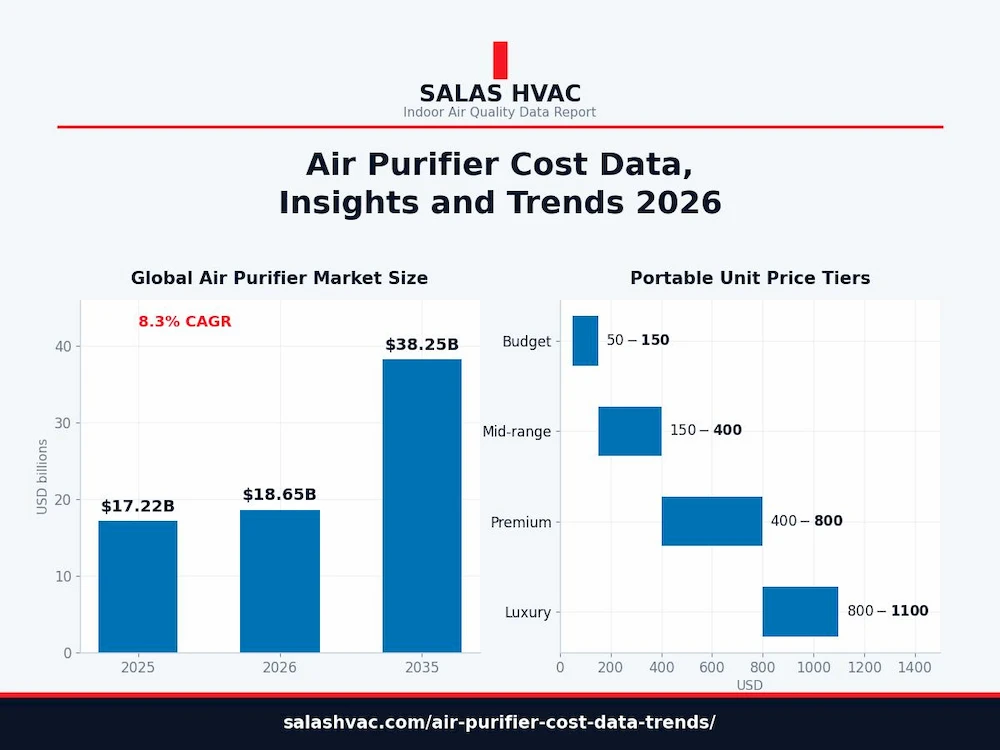
Air purifier cost data for 2026 shows a market that keeps getting bigger, smarter, and more affordable at the entry level. Most portable air purifiers cost between $100 and $900, while a whole-house system averages $2,610 installed.
We service, install, and test air quality equipment, so we track costs and the market data closely. We pulled together the latest price data, ownership costs, and trends so you can find the latest numbers here.
Air Purifier Cost Statistics at a Glance
Short on time? Here are the numbers that matter most for 2026.
- $17.22 billion is the global air purifier market size, heading to $38.25 billion by 2035 at an 8.3% CAGR.
- $100 to $900 is the price range where most effective portable air purifiers sit.
- $2,610 is the national average cost to install a whole-house air purifier.
- $0.84 billion is the US smart air purifier market size, growing at 14.92% per year.
- 52.4% is the revenue share HEPA filtration holds in the US smart purifier market.
How Much Does an Air Purifier Cost in 2026?
- A good portable air purifier costs $150 to $400 for most rooms.
- Small bedroom units start near $80.
- Large-room and premium models run $400 to $1,100.
- Whole-house air purification systems average $2,610 installed, with most projects falling between $419 and $4,962 depending on filter type and home size.
That spread looks wide because the market serves very different needs. A studio apartment needs something completely different from a 3,000-square-foot home with wildfire smoke exposure.
Price follows coverage area, filter quality, and sensor hardware more than brand names.
Here is how the portable price tiers break down in 2026:
| Price Tier | Typical Range | What You Get |
|---|---|---|
| Budget | $50 to $150 | Small rooms up to 250 sq ft, basic HEPA-type filters, manual controls |
| Mid-range | $150 to $400 | True HEPA plus carbon, air quality sensors, auto mode, 400 to 800 sq ft coverage |
| Premium | $400 to $800 | Large rooms, smart app control, quiet motors, multi-stage filtration |
| Luxury | $800 to $1,100+ | Designer units, formaldehyde sensing, whole-floor coverage |
Brand pricing confirms these tiers.
- Levoit units run $50 to $500
- Honeywell models cost $90 to $500
- Blueair ranges from $100 to $500
- Dyson sits at the top at $500 to $1,100.
We break down specific models and price-per-room math in our how much does an air purifier cost guide, so check that next if you want unit-level recommendations.
Whole-House Air Purifier Installation Costs
Portable units clean one room. Whole-house systems clean every room through your ductwork, and they cost more upfront.
The national average sits at $2,610 installed. Your filter choice sets the final bill:
- Flat filters: $100 to $250. Basic dust and lint capture.
- Extended media filters: $500 to $1,000. Better particle capture, yearly replacement.
- Electronic filters: $600 to $2,400. Low operating cost, no replacement media.
- UV light systems: $750 to $3,500. Target bacteria and viruses, not dust.
- True HEPA in-duct systems: $2,000 to $5,000 or more. Maximum particle removal, may need duct modifications.
One note from the field: true HEPA retrofits often require ductwork adjustments because dense HEPA media restricts airflow in standard residential systems. Budget an HVAC inspection ($100 to $500) before you commit.
Air Purifier Market Size and Growth Data
Air purifier prices make more sense when you see how fast this market is growing. Demand shapes supply, and supply shapes what you pay.
The global market hit $17.22 billion in 2025. Analysts project an 8.3% compound annual growth rate through 2035, which would put the market at $38.25 billion.
Two forces push this growth.
First, commercial building codes across OECD nations now include mandatory indoor air quality provisions.
Second, wildfire smoke, urban pollution, and public health campaigns keep consumer demand high.
US Smart Air Purifier Market Numbers
The smart segment grows even faster than the overall market. The US smart air purifier market is worth $0.84 billion in 2026, up from $0.73 billion in 2025. By 2031, analysts expect $1.68 billion, a 14.92% annual growth rate.
The EPA’s 2024 decision to tighten the annual PM2.5 standard to 9 micrograms per cubic meter accelerated this shift. Stricter air standards pushed purification from a lifestyle upgrade toward a health purchase.
Regional data matters here too. The Western US holds 24.6% of the national smart purifier market, the largest regional share, thanks to persistent wildfire smoke and strict California air regulations.
Segment Shares That Explain Pricing
Three segment numbers explain why certain features cost what they do:
- HEPA filtration holds 52.4% of US smart purifier revenue. Buyers pay for proven 99.97% particle removal at 0.3 microns, and manufacturers price accordingly.
- Portable units hold 67.2% market share. High volume keeps portable prices competitive and puts pressure on premium brands to justify their tags.
- Residential buyers account for 59.1% of the market. Home users set the pricing baseline, while commercial demand grows faster at 15.85% per year.
What Drives Air Purifier Prices?
Five factors decide the sticker price on any unit you consider.
1. Filter Technology
A genuine HEPA filter captures 99.97% of particles down to 0.3 microns. That certification costs money to earn and to maintain, so true HEPA units cost more than “HEPA-type” alternatives that use looser standards.
Activated carbon adds odor and VOC removal. Budget units include a thin carbon sheet. Premium models pack several pounds of carbon, and the price reflects it. If smells and gases concern you, read our breakdown of how carbon filters work before you spend extra.
2. Room Size and CADR
Manufacturers rate purifiers by square footage, but the Clean Air Delivery Rate (CADR) tells the real story. Bigger coverage needs bigger fans, stronger motors, and larger filters.
A 200-square-foot bedroom unit costs $80 to $150. A 1,000-square-foot living room model runs $300 to $700. Always compare CADR numbers, not marketing claims about room size.
3. Sensors and Smart Features
Particle sensors, auto modes, and app control add $50 to $200 to a unit’s price. Smart models grew fastest in 2025 because buyers want real-time air data, and that demand supports higher price points.
Our take after years of testing: an auto mode earns its premium. The unit runs hard only when air quality drops, which saves filter life and electricity.
4. Noise Engineering
Quiet motors and insulated housings cost more to build. Dyson’s large-room unit, for example, advertises 50% noise reduction over prior models, and its $500-plus pricing reflects that engineering.
5. Certification and Testing
Energy Star, AHAM Verifide, and CARB ozone compliance all add cost. They also protect you from exaggerated claims. A CARB-compliant unit will not emit harmful ozone, which matters if anyone in your home has asthma.
Running Costs: Filters and Electricity
The sticker price is only the first check you write. Smart buyers budget for ownership costs over five years.
Filter replacement runs $50 to $80 per year for most mid-range units. Premium brands can charge $100 to $200 annually. Subscription filter plans are spreading fast, and they now shape brand pricing strategy across the industry.
Electricity costs less than most people fear. A typical portable unit draws 30 to 60 watts on medium speed. Run it 24/7 and you pay about $2 to $5 per month at average US electricity rates.
Here is a realistic five-year ownership picture for a mid-range $250 unit:
| Cost Item | Year 1 | 5-Year Total |
|---|---|---|
| Unit purchase | $250 | $250 |
| Filters ($65/year) | $65 | $325 |
| Electricity ($4/month) | $48 | $240 |
| Total | $363 | $815 |
This math is why we tell homeowners to think in cost per year, not sticker price. A $400 unit with cheap filters often beats a $200 unit with $120 annual filter costs.
Replacement Filter Pricing by Tier
Filter costs vary more than the units themselves. Budget brands sell replacement HEPA cartridges for $20 to $35, but they need swapping every four to six months.
Premium brands charge $60 to $120 per filter, yet some last a full year.
The filter subscription trend matters here. Brands market these plans as convenience, but the real driver is recurring revenue, and analysts now track filter subscriptions as a core industry growth strategy.
Always convert a subscription into cost per year before you compare it against buying filters outright.
What About Refurbished and Secondhand Units?
Certified refurbished units from major brands typically sell for 20% to 40% below retail. That discount disappears fast if the unit ships with an old filter, so factor in an immediate $30 to $80 replacement.
Our rule of thumb: refurbished works for premium brands with available parts. Cheap secondhand units rarely pay off because a worn motor plus a new filter often costs more than a new mid-range unit with a warranty.
Air Purifier Cost Trends to Watch
Three trends will shape what you pay over the next few years.
First, filter subscriptions will spread. Brands now push “filter-as-a-service” plans that bundle replacements into monthly fees. This lowers the upfront price but raises lifetime cost. Do the five-year math before you subscribe.
Second, commercial-grade tech is moving into homes. ASHRAE 241 ventilation standards and WELL building certifications pushed sensor-equipped units into offices first. Those same sensors now appear in $200 home units, which raises baseline quality across price tiers.
Third, supply-chain reshoring may steady prices. Filter media production is moving closer to end markets, which cuts tariff exposure and shipping risk. Analysts expect this to keep price growth modest even as demand climbs.
If you are still deciding whether a purifier makes sense for your home at all, start with our helpful guide on whether you need one. And if viruses are your main concern, see what HEPA filters actually capture before you pay for a new device.
How to Budget Smart for Clean Air
Here is the process we walk Arizona homeowners through when they ask us at Salas HVAC what to buy. It works anywhere.
- Measure your room. Match CADR to square footage. Do not overbuy coverage you will never use.
- Pick your pollutant. Dust and pollen need HEPA. Odors and VOCs need carbon. Germs need UV or high-grade HEPA.
- Price the one year and five-year cost. Add unit, filters, and electricity. The cheapest unit rarely wins this math.
- Check certifications. AHAM Verifide for CADR, CARB for ozone safety, Energy Star for efficiency.
- Decide portable versus whole-house. One or two problem rooms favor portable units. Whole-home concerns favor duct-integrated systems.
For whole-home setups, professional sizing matters more than brand. Our air cleaning services page explains how duct-integrated purification works with your existing system.
FAQs
How much should I spend on an air purifier?
Budget $150 to $300 for reliable performance in most rooms. Spend $80 to $100 for a small bedroom only. Invest $400 to $700 for large spaces, severe allergies, or heavy odor removal. Beyond $800, you pay for design and quiet operation more than cleaning power.
Are expensive air purifiers worth it?
Premium models earn their price for specific jobs: medical-grade particle removal, heavy VOC loads, or very large rooms. For general dust, pollen, and pet dander, a $200 to $400 mid-range unit performs nearly as well as a $1,000 flagship.
What does an air purifier cost to run each month?
Most portable units add $2 to $5 per month to your electric bill when run continuously. Energy Star models on low or medium speed often cost under $20 per year. Filter replacements are the bigger expense at $50 to $80 annually.
Why did air purifier prices change after 2024?
The EPA tightened its annual PM2.5 standard to 9 micrograms per cubic meter in early 2024. Demand surged, smart-sensor models grew fastest, and manufacturers expanded every price tier. Competition kept entry prices stable while premium features multiplied.
Is one large purifier cheaper than several small ones?
Usually yes for open floor plans. One $500 large-room unit costs less to buy and filter than three $180 small units, and it uses less electricity. Closed bedrooms are the exception, because a closed door blocks airflow and each sealed room needs its own unit.
Sources
- Consumer Reports. “Air Purifier Buying Guide.” June 2026. https://www.consumerreports.org/appliances/air-purifiers/buying-guide/
- HomeAdvisor. “How Much Does a Whole-Home Air Purifier Cost?” 2025. https://www.homeadvisor.com/cost/cleaning-services/install-a-central-air-cleaner/
- Market Research Future. “Air Purifier Market Size, Share, Types, Trends, Report 2035.” August 2026. https://www.marketresearchfuture.com/reports/air-purifier-market-8148
- Mordor Intelligence. “US Smart Air Purifier Market Size and Share Analysis.” August 2026. https://www.mordorintelligence.com/industry-reports/us-smart-air-purifier-market