Ionizer air purifiers promise cleaner indoor air without expensive filter replacements. These devices use electrical charges to clump airborne particles together, causing them to fall from the air. But do ionizer air purifiers actually work as advertised, or are they a waste of money?
The team at Salas HVAC have tested and serviced air quality equipment across Arizona homes for decades. We have seen the real results and limitations of ionizer technology firsthand. Let’s break down exactly how ionizers function, what they can and cannot remove, and whether they deserve a place in your home.
How Does it Work?
Ionizer air purifiers operate using a process called corona discharge. High-voltage electrodes create an electrical field that strips electrons from air molecules.
This produces negative ions that attach to airborne particles like dust, pollen, and smoke.
Once particles gain an electrical charge, they clump together with other charged particles. These clusters become heavy enough to settle onto surfaces or stick to collection plates inside the unit.
Some advanced models combine ionization with HEPA filtration to trap charged particles more effectively.
The EPA explains that ion generators charge particles so they attract to walls, floors, and tabletops. However, these devices do not actually remove particles from your home.
The pollutants remain in your environment, waiting to be kicked back into the air.
What Ionizers Can Remove And What They Cannot
Ionizer air purifiers target specific types of indoor pollutants. Understanding their capabilities helps set realistic expectations.
Particles Ionizers Can Affect
- Tobacco smoke particles
- Some bacteria and mold spores
- Fine dust and certain allergens
- Pet dander (temporarily)
Research from Aerosol and Air Quality Research shows that unipolar ionizers can enhance particle wall deposition by a factor of two.
This means particles settle faster with ionization active.
Pollutants Ionizers Cannot Remove
- Gases like carbon monoxide
- Volatile organic compounds (VOCs)
- Odors without producing ozone
- Large particles like pollen effectively
Ionizers are ineffective for odors and gases, including VOCs released from paints and cleaning supplies. These compounds remain in your air even with an ionizer running.
The Ionizer Ozone Problem
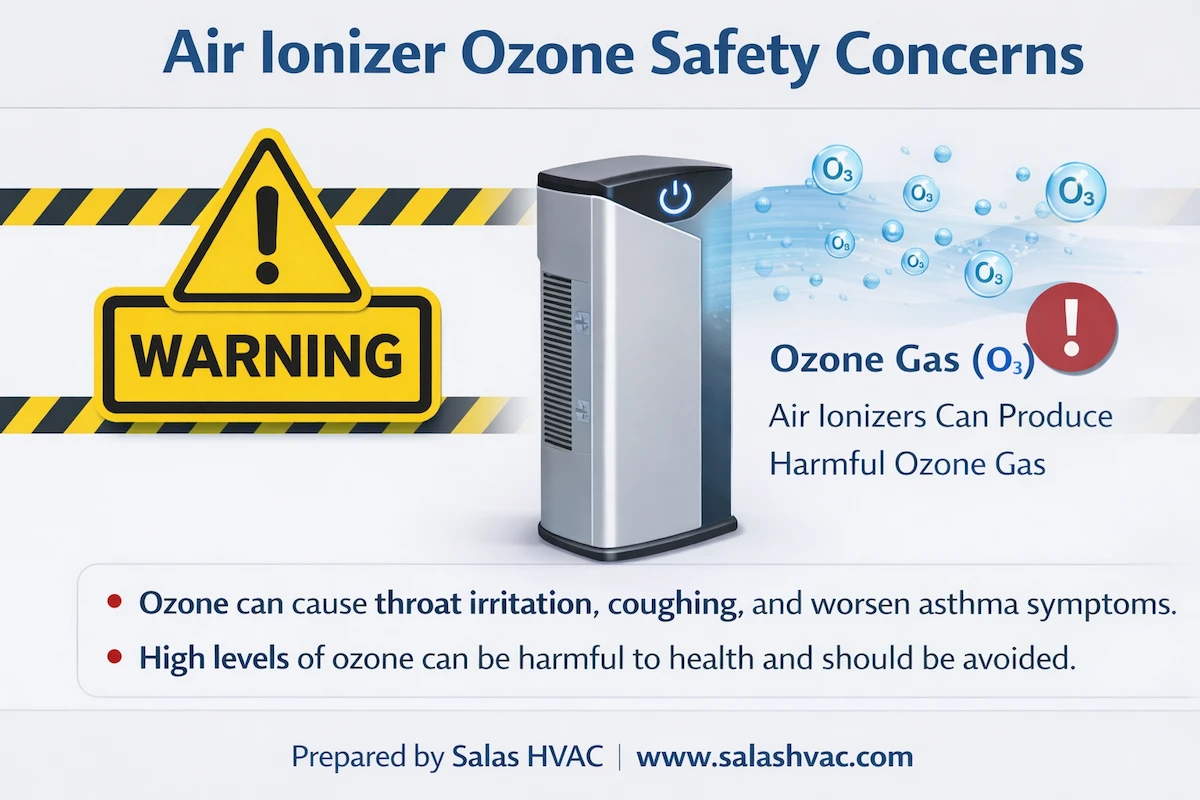
The biggest drawback of ionizer air purifiers is ozone production.
When ions charge airborne particles, they create ozone as a byproduct. This colorless gas causes serious health issues even at low concentrations.
The EPA warns that ozone is a lung irritant. Inhaling it can cause throat irritation, chest pain, coughing, and shortness of breath. Long-term exposure may reduce lung function and worsen asthma.
California Air Resources Board (CARB) certifies air cleaners that emit less than 0.050 parts per million of ozone.
Many ionizers fail this standard. Before purchasing any ionizer, verify CARB certification to protect your family’s health.
Ionizer vs. HEPA: Which Technology Works Better?
Comparing ionizers to HEPA filters reveals significant differences in effectiveness.
| Feature | Ionizer | HEPA Filter |
| Particle removal method | Electrical charging | Physical filtration |
| Capture rate | No standard measurement | 99.97% at 0.3 microns |
| Ozone production | Often yes | No |
| Maintenance | Clean collection plates | Replace filters periodically |
| Particle retention | Particles resettle | Trapped until disposal |
IQAir research confirms that ionizers do not actually remove particles from the air. They simply attach pollutants to nearby surfaces where they can become airborne again.
HEPA filters physically capture contaminants, removing them completely from your environment.
Do Ionizer Air Purifiers Work for Allergies?
Allergy sufferers need consistent particle removal, not temporary displacement. Ionizers fall short here.
While ionizers can cause allergen particles to drop from the air, they do not eliminate them.
Dust mites, pollen, and pet dander settle onto carpets, furniture, and bedding. Walking through a room or sitting on furniture re-releases these particles. Without proper filtration, allergy symptoms persist.
HEPA-based systems trap allergens in the filter media. You dispose of the filter, removing allergens permanently from your home.
This makes HEPA technology the preferred choice for asthma and allergy management.
Bipolar Ionization: A Better Alternative?
Bipolar ionization produces both positive and negative ions. Manufacturers claim this technology offers improved performance over standard negative ion generators.
However, research from Aerosol and Air Quality Research found that bipolar ionizers do not enhance particle wall deposition.
Unlike unipolar ionizers, the positive and negative ions neutralize each other, reducing overall effectiveness.
Bipolar ionization remains relatively new. Independent studies validating long-term safety and effectiveness are limited. Approach these claims with caution until more peer-reviewed research becomes available.
When Might Ionizers Make Sense?
Ionizers are not completely without merit. In specific scenarios, they provide modest benefits.
- Supplementing HEPA filtration in commercial HVAC systems
- Reducing airborne particles in unoccupied spaces
- Temporary odor control in industrial settings (with proper ventilation)
Some energy-efficient systems incorporate ionization as a secondary stage. When combined with mechanical filtration, ionizers may boost overall particle capture rates.
However, standalone ionizers rarely justify the investment for residential use.
FAQs
Do ionizer air purifiers actually clean the air?
Ionizers make particles heavier so they fall from the air, but they do not remove pollutants from your home. Particles remain on surfaces and can become airborne again. True air cleaning requires physical filtration like HEPA technology.
Are ionizer air purifiers safe to use daily?
Many ionizers produce ozone, which irritates lungs and worsens respiratory conditions. Check for CARB certification before using any ionizer in occupied spaces. Even certified units should be used with caution in homes with children, elderly residents, or people with asthma.
Can ionizers replace HEPA filters?
No. Ionizers and HEPA filters work differently. HEPA filters physically trap 99.97% of particles, while ionizers only cause particles to settle. For comprehensive air cleaning, HEPA filtration remains the gold standard.
Do ionizers remove viruses?
Some studies suggest ozone produced by ionizers can inactivate viruses. However, the ozone levels required for this effect often exceed safe health standards. HEPA filters capture virus particles physically without producing harmful byproducts.
The Bottom Line: Are Ionizer Air Purifiers Worth It?
Ionizer air purifiers offer limited benefits with significant drawbacks. They displace particles rather than removing them, produce potentially harmful ozone, and fail to address gases or VOCs.
For homeowners serious about indoor air quality, we recommend air purification systems with true HEPA filtration and activated carbon. If you are considering air quality improvements, skip the ionizer gimmicks. Invest in proven technology that actually removes pollutants from your home.
Breathe easy,
Michael
Sources
Aerosol and Air Quality Research. “Effect of Ionizers on Indoor Air Quality and Performance of Air Cleaning Systems.” December 2023.
https://aaqr.org/articles/aaqr-23-10-oa-0240
IQAir. “Air Ionizers for Home: Benefits and Drawbacks.” June 2019.
https://www.iqair.com/us/newsroom/understand-the-ionizer-air-purifier-are-they-safe-and-effective
U.S. Environmental Protection Agency. “Ozone Generators that are Sold as Air Cleaners.” September 2025.
https://www.epa.gov/indoor-air-quality-iaq/ozone-generators-are-sold-air-cleaners
U.S. Environmental Protection Agency. “What are ionizers and other ozone generating air cleaners?”
https://www.epa.gov/indoor-air-quality-iaq/what-are-ionizers-and-other-ozone-generating-air-cleaners