Air ionizers have been marketed as a modern solution for indoor air quality. But what exactly is an ionizer, and should you trust one to clean the air in your home?
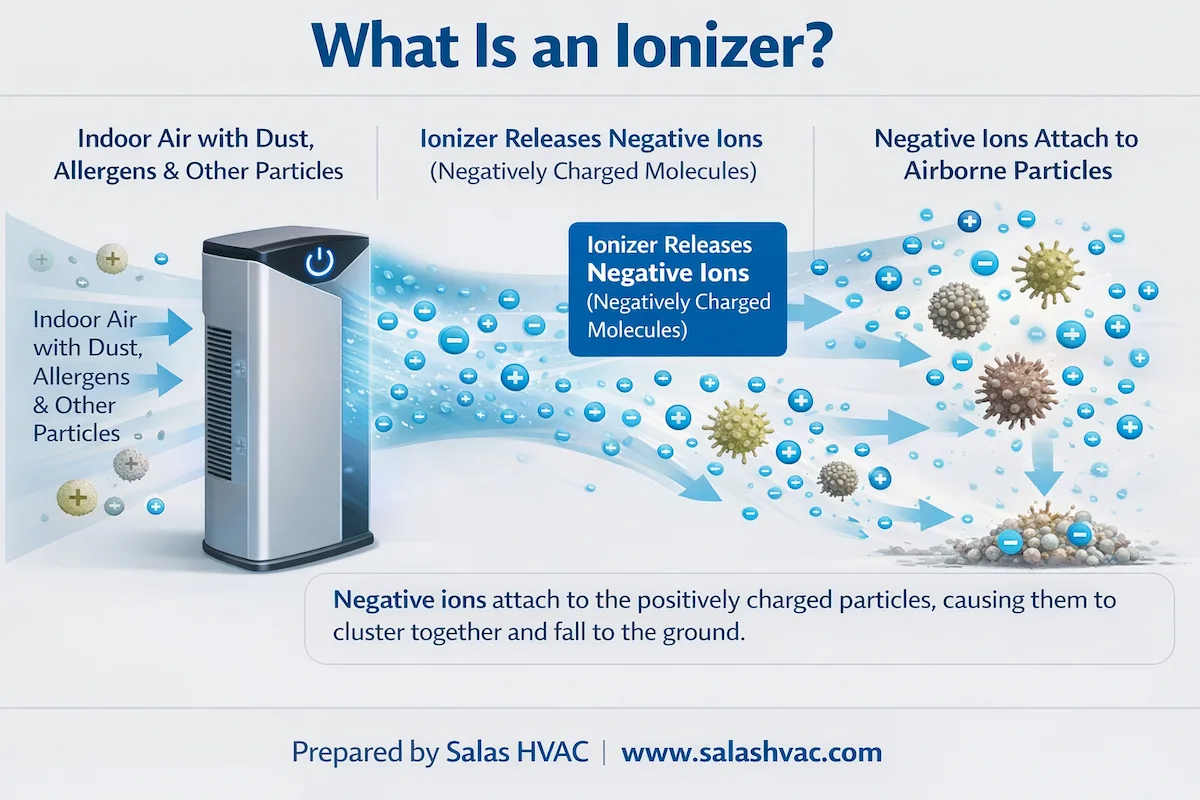
An ionizer is a device that releases electrically charged particles called negative ions into the air. These ions attach to airborne contaminants like dust, pollen, and smoke, causing them to become heavy and fall to surfaces rather than float in the air you breathe.
The technology sounds promising. But there’s more to the story than manufacturers typically share.
How Air Ionizers Work
Ionizers operate using high-voltage electrodes that charge air molecules.
When you turn on an ionizer, it creates what’s called a corona discharge effect.
Air molecules near the electrodes gain or lose electrons. Most ionizers produce negative ions, though some models can generate positive ions too.
The Science Behind Negative Ions
Negative ions are simply oxygen molecules that have picked up an extra electron. This gives them a negative electrical charge.
When released into your room, these charged particles don’t stay alone for long. They immediately start looking for particles with opposite charges to attach to.
Most airborne pollutants carry a positive or neutral charge. The negative ions bond with these particles through electrostatic attraction, similar to how a magnet works.
What Happens to Airborne Particles
Once negative ions attach to dust, pollen, or other contaminants, the particles become heavier. They can no longer float freely in the air.
The clumped particles fall onto surfaces in your home. This includes your floors, walls, furniture, bedding, and even your clothing.
Here’s the catch: the particles aren’t actually removed from your environment. They’re just relocated from the air to your surfaces. When you sit on your couch or walk across the floor, you can kick these particles right back into the air.
The effectiveness of ionizers depends heavily on what type of pollution you’re trying to address. Most ionizers simply aren’t strong enough to make a noticeable difference.
A scientific review of air ionizer tests found that most units have no measurable effect on particulate levels. The ionizers that do show results use much stronger electrical charges than typical consumer models.
Performance Against Dust and Allergens
Ionizers can make some dust and pollen particles clump together and settle. But this creates two problems.
First, the particles end up on your belongings instead of being trapped in a filter. Second, normal activities like walking or opening doors stir these particles back into the air.
Consumer Reports tested popular ionizer models and found their clean air delivery rates were far below mechanical filters. The magazine gave several prominent ionizer products a “fail” rating based on their poor performance.
Limitations with Gases and VOCs
Ionizers work only on particles with physical mass. They cannot affect gases, chemicals, or volatile organic compounds.
If you’re dealing with smoke odors, cooking smells, or VOCs from household products, an ionizer won’t help. The ionization process simply doesn’t interact with gaseous pollutants.
The Ozone Problem You Need to Know About
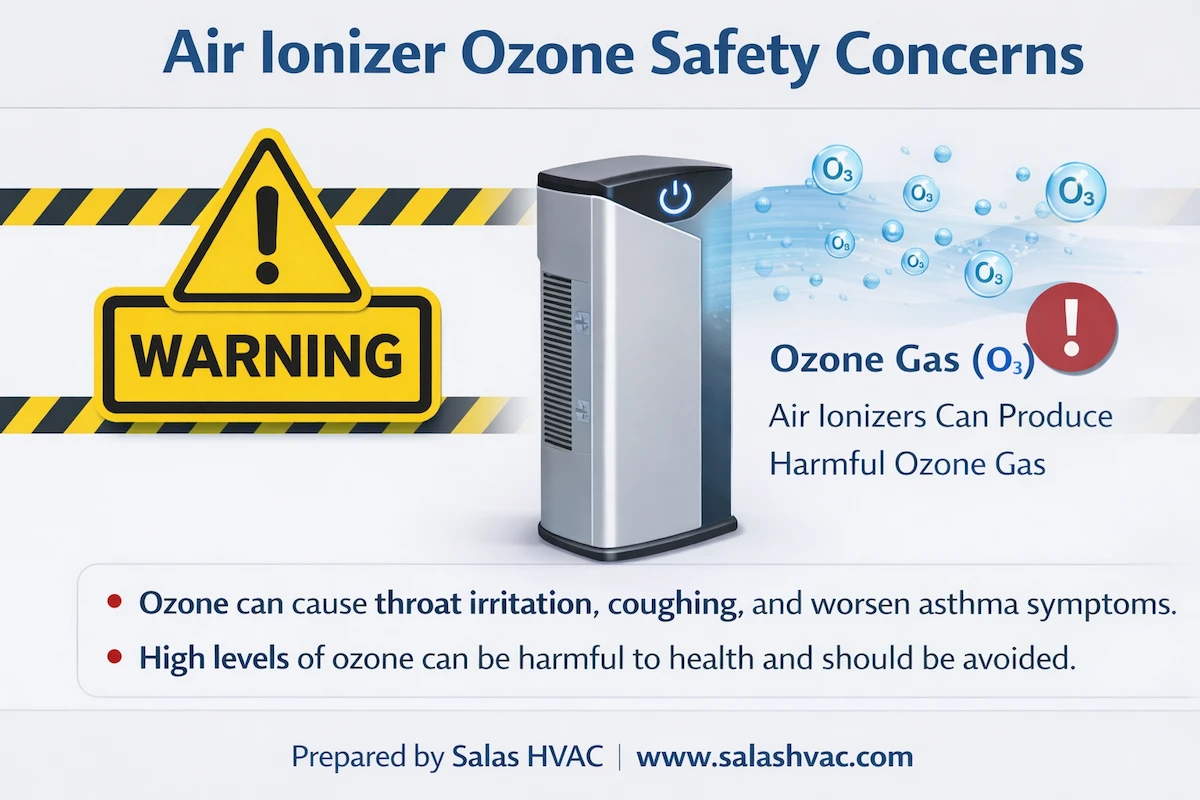
This is where ionizers become concerning for indoor air quality. Many ionizer models produce ozone as a byproduct.
Ozone is a respiratory irritant. It’s the same gas that makes up smog in polluted cities.
How Ionizers Create Ozone
When ionizers charge air molecules with high voltage, some oxygen molecules are converted into ozone. This happens naturally during the ionization process.
The stronger the ionizer’s electrical charge, the more ozone it produces. Those powerful ionizers that actually show cleaning results? They’re also the ones generating the most ozone.
Health Risks from Ozone Exposure
The EPA has set clear limits on ozone production for medical devices: no more than 0.05 parts per million. But these tests happen in controlled laboratories.
Your home is not a lab. When ozone mixes with cleaning products, nail polish, or other household chemicals, it can trigger reactions that create even more harmful pollutants like formaldehyde.
Ozone exposure can cause chest pain, coughing, shortness of breath, and throat irritation. People with asthma or other respiratory conditions face higher risks.
In spring 2021, a group of doctors wrote an open letter to school officials across the country. They pleaded with schools never to purchase air cleaners with ionizers, citing studies showing harmful chemical concentrations can build up in real-world settings.
Ionizer vs HEPA Filter: Which Cleans Better?
HEPA filters physically capture particles as air passes through dense filter material. The U.S. military developed this technology during World War II, and it hasn’t needed much improvement since then.
A HEPA filter traps 99.97% of particles as small as 0.3 microns. This includes dust, pollen, mold spores, bacteria, and many viruses. The particles stay locked in the filter until you replace it.
HEPA filtration doesn’t produce any ozone or other byproducts.
It’s purely mechanical. An EPA review confirmed that HEPA filters combined with activated carbon are the most effective air cleaning technology available.
Ionizers merely make particles stick to surfaces. HEPA filters actually remove them from your environment. The difference matters for anyone with allergies, asthma, or other respiratory sensitivities.
At Salas HVAC, we’ve tested both technologies in Arizona homes. HEPA-based systems consistently deliver better results without the ozone concerns. We install professional air purification systems that use proven filtration methods.
When Should You Consider an Ionizer?
Most homes don’t benefit from standalone ionizer units. The effectiveness is questionable, and the ozone risk is real.
Some modern air purifiers include a small ionizer feature alongside HEPA filtration. Manufacturers add this to slightly boost the filter’s particle capture rate. If you buy one of these combination units, make sure it has an option to turn the ionizer off.
Ionizers do have legitimate uses in industrial settings. Electronics manufacturing facilities use them to eliminate static electricity buildup near sensitive components. But these are specialized applications, not home air cleaning.
If someone in your home has respiratory issues or if you’re concerned about indoor air quality, skip the ionizer. Choose a quality HEPA filter system instead.
The only exception might be if you’re specifically trying to reduce bacteria in a hospital or clinical setting. Some research suggests strong ionizers can inactivate certain bacteria, but this requires careful professional implementation.
FAQs
Are ionizer air purifiers safe to use indoors?
Many ionizers produce ozone levels that exceed EPA safety guidelines for indoor use. The ozone can react with household chemicals to create additional pollutants. Choose CARB-certified models if you must use an ionizer, and never run them in rooms where people with respiratory conditions spend time.
Can ionizers remove viruses from the air?
Research shows that ozone produced by ionizers can inactivate some viruses on surfaces and in the air. A 2020 scientific review found ozone effective against SARS viruses. But the ozone levels required for virus inactivation are higher than safe levels for human exposure. Running an ionizer strong enough to kill viruses puts your respiratory health at risk.
How often do I need to clean surfaces with an ionizer running?
Ionizers cause particles to fall onto every surface in the room. You’ll need to vacuum floors and wipe down furniture, walls, and other surfaces at least twice per week to prevent particle buildup. Otherwise, normal movement will kick the accumulated dust and allergens back into the air. This is one reason why HEPA filters that actually trap and contain particles are more practical.
Do all air purifiers have ionizers?
No. Many quality air purifiers use only HEPA filters and activated carbon without any ionization. Check the product specifications before buying. If an air purifier does include an ionizer, it should have a switch to turn that feature off.
Breathe easy,
Michael
Sources
Air Ionizer Benefits. (December 30, 2014). Air Oasis.
https://www.airoasis.com/blogs/knowledgebase/air-ionizer-benefits
Air Ionizers: How They Work, Benefits & Drawbacks. (August 29, 2021). Healthline.
https://www.healthline.com/health/what-does-an-ionizer-do
Air Ionizers for Home: Benefits and Drawbacks. (June 7, 2019). IQAir.
https://www.iqair.com/us/newsroom/understand-the-ionizer-air-purifier-are-they-safe-and-effective
Do Ionizer Air Purifiers Work and Are They Safe? (December 11, 2025). Intellipure.
https://www.intellipure.com/a/blog/post/do-ionizer-air-purifiers-work-and-are-they-safe
Ionic Air Purifier vs HEPA. (October 27, 2020). Oransi.
https://oransi.com/blogs/blog/ionic-air-purifiers-vs-hepa-air-purifiers
Review by the EPA Warns Against ESP and Ionizer Air Purifiers, A. (March 28, 2023). Austin Air Systems.
https://austinair.com/a-review-by-the-epa-warns-against-esp-and-ionizer-air-purifiers/
What are ionizers and other ozone generating air cleaners? (March 11, 2025). US EPA.
https://www.epa.gov/indoor-air-quality-iaq/what-are-ionizers-and-other-ozone-generating-air-cleaners