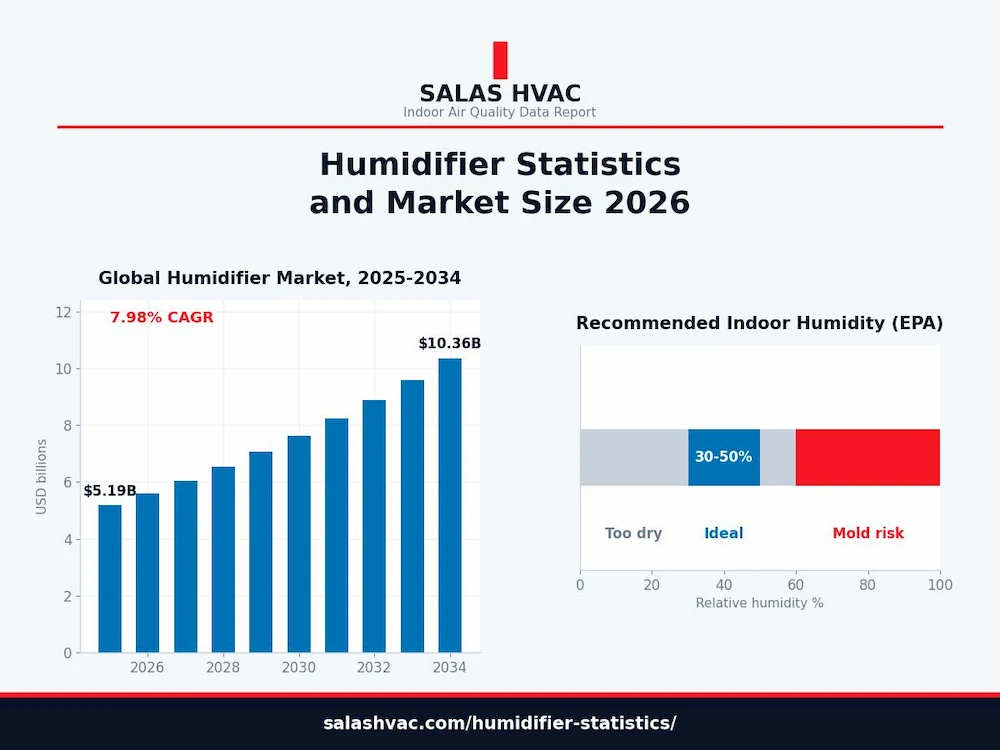
Humidifier statistics reveal a quiet boom. The global humidifier market was valued at $5.19 billion in 2025 and will grow to $5.61 billion in 2026, then nearly double to $10.36 billion by 2034 at a 7.98% annual growth rate.
Homeowners, hospitals, data centers, and factories all buy humidification now. What used to be a $40 drugstore appliance has become a serious product category with smart controls, HVAC integration, and energy-efficient designs.
This report gathers the current market data, type-by-type breakdowns, regional numbers, and air humidifier statistics behind the growth. We work with professional humidification systems daily in America’s driest states, so you will also get our practical read on what the numbers mean for you.
Humidifier Statistics at a Glance
Short on time? These numbers define the humidifier market in 2026.
- $5.19 billion: global humidifier market size in 2025, on the conservative estimate.
- $10.36 billion: the projected market by 2034, meaning the category nearly doubles in under a decade.
- 7.98% to 8.81%: the annual growth range both major research firms project.
- 30% to 50%: the indoor relative humidity range the EPA recommends for comfort and mold prevention.
- $400 to $2,500: the installed cost range for a whole-house humidifier.
- 90%: the share of time Americans spend indoors, where humidity control happens.
Humidifier Market Size: The 2026 Numbers
- The global humidifier market is worth $5.19 to $6.24 billion in 2025, depending on the research firm.
- Annual growth runs between 7.98% and 8.81%.
- Forecasts reach $10.36 billion by 2034 on the conservative end and $11.27 billion by 2032 on the aggressive end.
| Research Firm | 2025 Size | 2026 Size | Forecast | CAGR |
|---|---|---|---|---|
| Fortune Business Insights | $5.19 billion | $5.61 billion | $10.36 billion by 2034 | 7.98% |
| 360iResearch | $6.24 billion | $6.77 billion | $11.27 billion by 2032 | 8.81% |
360iResearch counts a broader product set, which explains the higher base.
Both agree on the trajectory: this market doubles in under a decade. For a product category that most shoppers still treat as an afterthought, that is a remarkable growth curve.
For context, humidifiers now sit inside the wider indoor air quality economy rather than the small-appliance aisle.
Analysts describe them as “essential infrastructure rather than optional comfort devices” for homes, offices, hospitals, data centers, and manufacturing facilities.
Why Humidifier Demand Keeps Growing
Four measurable trends push this market forward.
Health Awareness After the Pandemic
Buyers now connect indoor humidity to respiratory health. Dry air irritates airways, worsens allergy symptoms, and cracks skin.
Market analysts name “rising prevalence of dry indoor conditions” and air quality awareness as the top demand factor.
The EPA recommends keeping indoor relative humidity between 30% and 50% to reduce mold risk and support respiratory comfort.
Much of the US drops below that range every winter, and desert climates like Arizona stay below it year-round.
Smart Controls and Energy Efficiency
Smart humidistats, app control, and HVAC-integrated designs reshaped the product category.
Analysts flag smart controls and energy-efficient designs as the forces “reshaping product offerings” across the market.
Efficiency matters because humidification adds to energy bills if done badly. Pairing humidity control with efficient equipment pays off, which is why we point homeowners toward Energy Star certified systems when they upgrade.
Commercial and Industrial Adoption
Hospitals need humidity control for patient comfort and infection management. Data centers need it to prevent static discharge that damages servers.
Manufacturers need it for material preservation and process consistency.
This institutional demand gives the market a stable floor. Consumer sales swing with seasons and trends. Hospital and data center contracts do not.
HVAC-Integrated Whole-House Systems
The fastest product shift we see in the field: homeowners skipping portable units and going straight to duct-integrated humidification.
A whole-house humidifier costs $400 to $2,500 installed and treats every room through existing ductwork.
Our whole-house humidifier services page covers how these systems tie into your furnace or air handler.
Seasonal Buying Patterns
Humidifier sales spike every fall as heating season approaches and indoor air dries out. Retailers stock deep from October through January, and discounting starts in late winter when demand drops.
The exception is the desert Southwest. In Arizona and Nevada, air conditioning strips moisture from indoor air all summer, so demand holds nearly flat across seasons.
Our own service calendar confirms it: dry-air calls arrive in July almost as often as January.
Energy Use and Operating Costs
Portable humidifiers are cheap to run. An evaporative unit draws about as much power as a light bulb, while steam vaporizers use several times more because they boil water.
Ultrasonic models sit at the low end, which partly explains their popularity in bedrooms.
Whole-house systems shift the cost from electricity to water and maintenance.
Bypass and fan-powered units add modest utility costs, but they need annual pad or wick replacement and occasional descaling in hard-water regions. Skip the maintenance and mineral buildup chokes output within a season or two.
Humidifier Statistics by Product Type
The market splits into four technology families. Each owns a different niche.
- Evaporative humidifiers use a wick filter and fan. They self-regulate because evaporation slows as humidity rises. They dominate the residential mid-market and whole-house installations.
- Ultrasonic humidifiers vibrate water into a fine mist. They run nearly silent and lead the bedroom and nursery segment. They cost more than basic evaporative models.
- Steam vaporizers boil water to create warm mist. They kill bacteria during boiling but use more electricity than any other type. Healthcare settings favor them for sterility, and cold-and-flu season drives a yearly consumer spike.
- Impeller humidifiers fling water at a diffuser with a rotating disc. They serve the budget cool-mist niche, mostly for children’s rooms.
Portable units still outsell whole-house systems by unit count. But whole-house installations pull more revenue per sale, and their share climbs every year as HVAC-integrated humidification gains adoption.
Regional Humidifier Market Data
Geography shapes humidity needs, and the sales map proves it.
North America buys heavily in two opposite climates. Cold northern states need humidification all winter because heated air dries out fast. Desert Southwest states like Arizona and Nevada need it year-round. We see this firsthand: our service calls for dry-air complaints peak in both January and July.
Asia-Pacific posts strong growth on urbanization and rising incomes. New apartment construction in dry-climate regions of China and India opens fresh demand each year.
Europe grows steadily on energy-efficient building renovations. Tight, well-insulated homes trap dry heated air, which makes mechanical humidification more common in new builds.
Middle East and Latin America represent smaller but faster-growing markets. Gulf states pair aggressive air conditioning with desert outdoor air, a combination that pulls indoor humidity down hard. Analysts expect these emerging regions to outpace mature markets in percentage growth through the early 2030s.
The pattern across all regions is the same: wherever heating or air conditioning runs for long seasons, indoor air dries out, and humidifier sales follow. Climate, not income, is the single best predictor of demand.
Humidity, Health, and Your Home: The Numbers That Matter
Market size tells you what people buy. These numbers tell you why it works.
- 30% to 50%: the indoor relative humidity range the EPA recommends for comfort, mold prevention, and respiratory health.
- Below 30%: humidity levels where dry skin, irritated sinuses, and static electricity become common complaints.
- Above 60%: the threshold where mold and dust mites thrive. Humidification without monitoring can overshoot, which is why smart humidistats matter.
- 90%: the share of time Americans spend indoors, where humidity control actually happens.
One caution from the field: over-humidification causes as many problems as dry air.
Window condensation, musty smells, and dust mite blooms all follow excess moisture, and we get those calls every winter from homeowners who set a humidifier to maximum and walked away.
If your home already feels damp, you need the opposite tool. Our dehumidifier services cover that side of the equation.
Dry air also makes dust worse. Low humidity keeps particles airborne longer instead of letting them settle. If dust is your main complaint, read our tested methods for reducing dust at home alongside your humidity plan.
Humidifier Maintenance: The Health Side of the Data
A humidifier only helps if you keep it clean. A neglected tank grows bacteria and mold, then aerosolizes them into the room you were trying to improve.
The EPA instructs owners to empty tanks daily, dry all surfaces, and refill with fresh water for exactly this reason.
Water choice matters too. Tap water carries minerals that ultrasonic units disperse as fine white dust, which settles on furniture and adds particles to your air.
Distilled water eliminates the problem, and demineralization cartridges reduce it.
Whole-house systems avoid most of these issues because they evaporate water from a pad rather than aerosolizing standing water.
They still need annual pad changes, but the health risk profile is far lower than a dirty portable tank.
Who Is Buying: Residential Versus Commercial
Residential buyers drive unit volume, but commercial and institutional buyers anchor revenue.
Hospitals, schools, offices, and data centers buy larger equipment on multi-year contracts, which gives manufacturers predictable income between consumer seasons.
The healthcare segment deserves special attention.
Humidity control supports patient comfort and helps manage airborne infection risk, so hospital-grade requirements push engineering standards that later reach consumer products.
Humidifier Market Trends to Watch
Hygrometer integration becomes standard. Built-in humidity sensors with auto shut-off moved from premium models to mid-range units. Expect them under $50 within two years.
Subscription filter and wick plans expand. Manufacturers copy the air purifier playbook: sell the unit cheap, bill replacements monthly. Compare lifetime costs before you commit to a plan, because a $40 unit with a $10 monthly plan costs $160 in year one alone.
Data center demand spikes. AI compute growth means more server halls, and every server hall needs precise humidity control to prevent static damage. This institutional segment will pull commercial-grade technology into the residential market over time.
Portable units keep shrinking the gap. Mid-range portables now ship with sensors, auto modes, and app control that only whole-house systems had five years ago. That feature migration keeps the portable segment competitive even as duct-integrated adoption climbs.
For a broader view of how humidifiers fit into healthy indoor air, see our indoor air quality data roundup.
FAQs
How big is the humidifier market in 2026?
The global humidifier market is worth $5.61 to $6.77 billion in 2026, depending on research scope. Fortune Business Insights projects $10.36 billion by 2034 at 7.98% annual growth. 360iResearch projects $11.27 billion by 2032 at 8.81% growth.
What humidity level should a home have?
Keep indoor relative humidity between 30% and 50%. Below 30%, you get dry skin, irritated airways, and static. Above 60%, mold and dust mites multiply. A $15 hygrometer tells you where your home sits.
Are whole-house humidifiers worth the cost?
Yes for homes in dry climates or with forced-air heating. A whole-house system costs $400 to $2,500 installed and humidifies every room evenly with no daily refilling. Portable units make more sense for renters or single-room needs.
Do humidifiers help with allergies?
Proper humidity soothes dry, irritated airways, which eases some allergy-like symptoms. But humidity above 60% feeds dust mites and mold, two major allergens. Keep levels between 30% and 50% and pair humidification with filtration for real allergy relief.
Which type of humidifier sells the most?
Evaporative models dominate residential sales because they self-regulate and cost less to run. Ultrasonic units lead the bedroom and nursery niche on quiet operation. Steam vaporizers hold a smaller share, concentrated in healthcare and cold-and-flu seasonal use.
Sources
- 360iResearch. “Humidifier Market: Global Forecast 2026-2032.” August 2026. https://www.360iresearch.com/library/intelligence/humidifier
- Fortune Business Insights. “Humidifiers Market Size, Share and Statistics, Trends Report 2034.” August 2026. https://www.fortunebusinessinsights.com/humidifiers-market-112749
- HomeAdvisor. “How Much Does a Whole-Home Air Purifier Cost?” 2025. https://www.homeadvisor.com/cost/cleaning-services/install-a-central-air-cleaner/
- US Environmental Protection Agency. “Indoor Air Quality: Report on the Environment.” May 2026. https://www.epa.gov/report-environment/indoor-air-quality