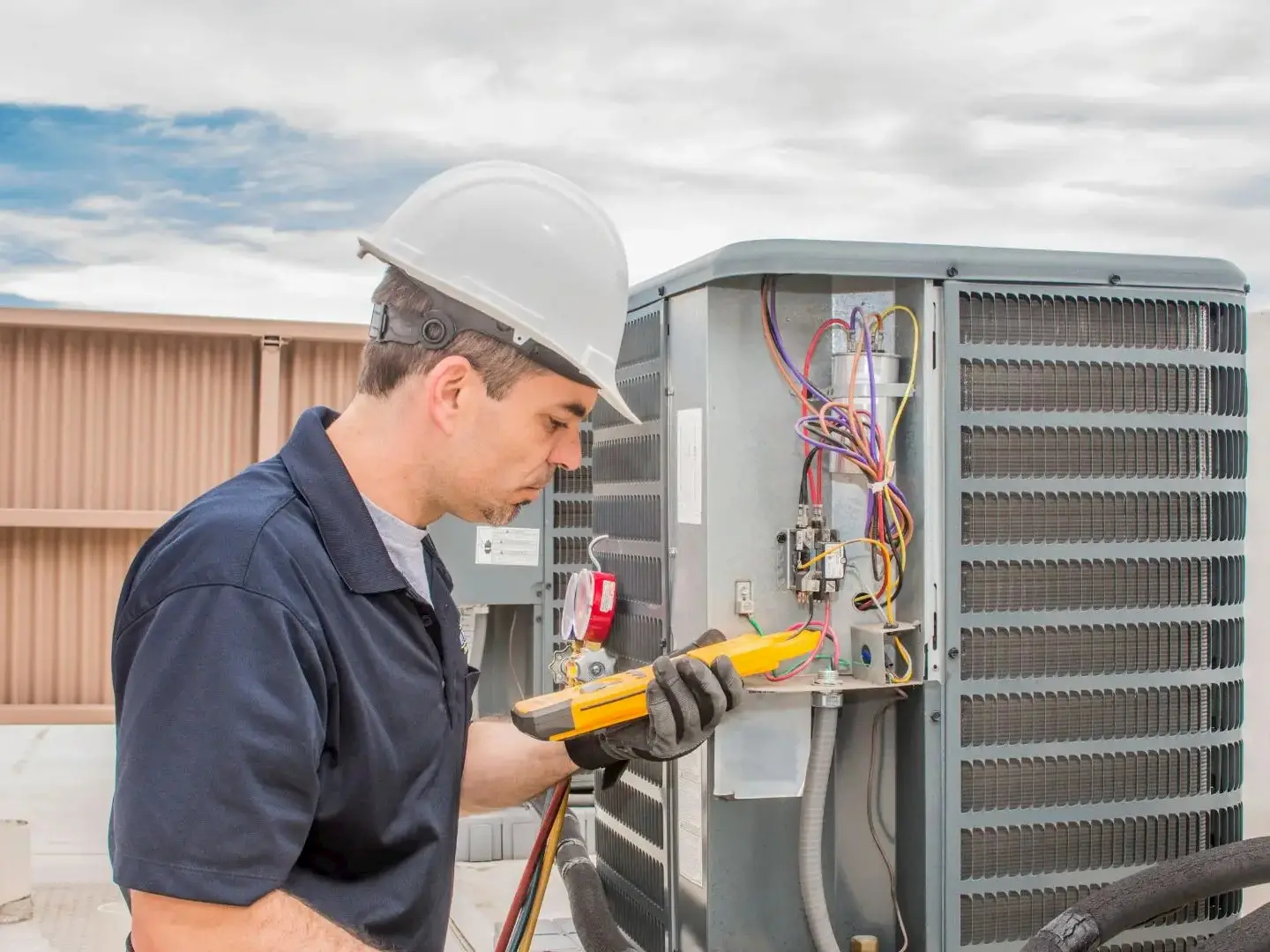
Most homeowners don’t realize their AC unit has two completely different capacitors doing two completely different jobs, and mixing them up means replacing a $15 part with a $60 part that burns out in a week. The difference between start and run capacitors determines whether your repair actually holds.
A start capacitor gives the motor a short, powerful jolt to get it spinning, then disconnects once it reaches operating speed. A run capacitor stays in the circuit continuously, keeping the motor running efficiently under load.
Read on to see how to tell them apart, test them, and pick the right replacement.
What Does an AC Capacitor Do?
Think of a capacitor as your AC motor’s short-term battery booster. It stores and releases electrical energy to help motors start and run efficiently.
Your compressor and fan motors need a powerful jolt to overcome inertia and begin spinning.
Once moving, they need steady, consistent power to run smoothly.
That’s where the two specialized capacitors come in.
You can usually find these cylindrical components inside your outdoor condenser unit.
They work hard, and because of this, capacitor failure is one of the most common reasons for AC repair calls.
Differences Between Start Capacitor and Run Capacitor
Physical Differences You Can See
You can often tell them apart by sight.
- A start capacitor is usually a black plastic cylinder.
- A run capacitor is typically a silver or gray metal can, round or oval.
- A dual run capacitor, which combines two functions, is also metal but will have three terminals instead of two.
What is a Start Capacitor?
A start capacitor has one critical job: provide a powerful, instantaneous burst of energy to get the motor spinning.
It gives your AC’s compressor the extra torque it needs to overcome initial resistance and start rotation.
This capacitor only works for a fraction of a second. It engages when the thermostat calls for cooling and disconnects from the circuit once the motor reaches about 75% of its full speed.
A relay or a PTC (positive temperature coefficient) device typically handles this disconnection.
Start Capacitor Specifications
Start capacitors are built for short, powerful bursts. You can identify them by their key specs:
- High Capacitance: They have a much higher microfarad (µF or MFD) rating, typically ranging from 70 to 120 µF or more. This high value allows them to store the large energy charge needed for startup.
- Lower Voltage: They often use lower voltage ratings like 125V, 165V, 250V, or 330V.
- Plastic Case: They are usually housed in a black plastic or Bakelite case, which is a clue to their short-duty-cycle design.
How a Start Capacitor Operates
The operation is a quick motion:
- When you turn on your AC, the start capacitor delivers its stored energy to the motor’s start winding.
- This creates a phase shift that generates a strong rotating magnetic field, spinning the motor shaft.
- Within 0.6 to 0.8 seconds, it’s out of the circuit, its job done until the next cycle.
What is a Run Capacitor?
While the start capacitor is the sprinter, the run capacitor is the marathon runner. Its purpose is continuous operation.
After the motor starts, the run capacitor remains in the circuit, providing a steady, phase-shifted current to the motor’s auxiliary winding for the entire run cycle.
This continuous boost improves the motor’s efficiency, provides more consistent torque, reduces noise, and helps the motor run cooler. It’s essential for smooth, reliable performance.
Run Capacitor Specifications
Run capacitors are built for endurance:
- Lower Capacitance: Their microfarad rating is lower, commonly between 5 and 50 µF.
- Higher Voltage: They are rated for continuous higher voltage, typically 370V or 440V. You can safely replace a 370V capacitor with a 440V one, but never the reverse.
- Metal Case: They are most often housed in a round or oval steel or aluminum case, which helps dissipate heat from continuous use.
How a Run Capacitor Operates
The run capacitor is always on duty when the motor runs. It constantly corrects the power factor and supplies a steady electrical field.
This keeps the motor rotating efficiently and prevents the power dips and surges that cause strain and overheating.
If it fails, the motor may struggle, run hot, or stop working entirely.
What is a Dual Run Capacitor?
To save space and cost, most modern AC units use a dual run capacitor.
It’s a single metal can that contains two separate capacitor sections: one for the compressor and one for the fan motor.
It has three terminals labeled:
- C (Common): Connects to the power source.
- HERM (Hermetically Sealed Compressor): Connects to the compressor motor.
- FAN: Connects to the condenser fan motor.
This clever design handles the continuous run needs of both critical motors with one component.
Troubleshooting: Is My AC Capacitor Bad?
Capacitors have a finite lifespan, often between 10-15 years, but extreme heat can shorten it. Recognizing the signs can prevent a complete system shutdown.
Common Symptoms of a Failing Capacitor
- Humming but Not Starting: A loud hum from the outdoor unit often means the motor is trying to start but can’t, pointing to a weak start capacitor.
- No Cold Air: If the fan runs but the air isn’t cold, the compressor might not be starting due to a bad capacitor.
- Hard Starting: Your lights dim for a second when the AC kicks on. This indicates the capacitor is struggling to provide the necessary startup jolt.
- Random Shut-Offs: A system that short-cycles (turns on and off frequently) may have a run capacitor that can’t sustain steady operation.
- Visible Damage: Never touch the capacitor. From a safe distance, look for bulging, leaks, or a popped top. These are clear signs of failure.
- Burning Smell: Any electrical burning odor from the unit requires immediate professional attention.
Capacitor Failure: The #1 Cause of AC Breakdowns
Our service data shows capacitor problems are the most frequent point of failure in air conditioners.
They account for approximately 30% of all AC failures, ahead of refrigerant leaks and compressor issues. That’s why understanding this component is so important for homeowners.
Can You Use a Start Capacitor as a Run Capacitor?
No, this is dangerous and will damage your system.
A start capacitor is designed for brief, high-energy bursts.
If you leave it energized in a continuous run circuit, it will overheat rapidly.
It can burst, leak electrolyte, or cause a serious electrical fault.
Technicians sometimes use multiple run capacitors in an array to assist with starting in specific situations, but a single run capacitor cannot replace the high-torque function of a dedicated start capacitor.
Always replace a capacitor with the exact type and microfarad (µF) rating specified for your unit.
FAQs
How much does it cost to replace an AC capacitor?
The average cost for professional capacitor replacement ranges from $100 to $400, including parts and labor. The price depends on the capacitor type, your location, and the service call.
Can I test or replace the capacitor myself?
We strongly advise against it. AC capacitors store high-voltage electricity (even with the power off) that can deliver a lethal shock. Diagnosis requires a multimeter, and incorrect replacement can destroy the expensive compressor. This is a job for a licensed HVAC technician.
What’s the lifespan of an AC capacitor?
Typically 10 to 15 years, but extreme conditions like Arizona’s summer heat can accelerate wear. Annual AC maintenance, where a technician checks the capacitor’s health, is the best way to extend its life.
My AC has one metal can with three wires. Is that a start or run capacitor?
That’s a dual run capacitor. It combines the continuous run functions for both the compressor and the fan motor into one unit.
When to Call a Professional HVAC Technician
Any time you suspect a capacitor issue, call a pro. Dealing with high-voltage components is not a safe DIY project!
A technician from Salas HVAC will:
- Safely discharge the stored electricity in the old capacitor.
- Test it with a multimeter to confirm failure.
- Replace it with a correctly rated, high-quality capacitor.
- Check for underlying issues that may have caused the failure.
- Ensure your entire system is running safely and efficiently.
Stay cool,
Michael