Commercial and industrial air purifier statistics reveal a market that quietly outgrows the residential one. Businesses, schools, hospitals, and factories now buy most of the world’s air cleaning equipment.
New building standards, stricter workplace rules, and hard data on productivity all push this growth. Scroll down to find the latest 2026 numbers and statistics for commercial air purifiers.
Commercial and Industrial Air Purifier Market at a Glance 2026
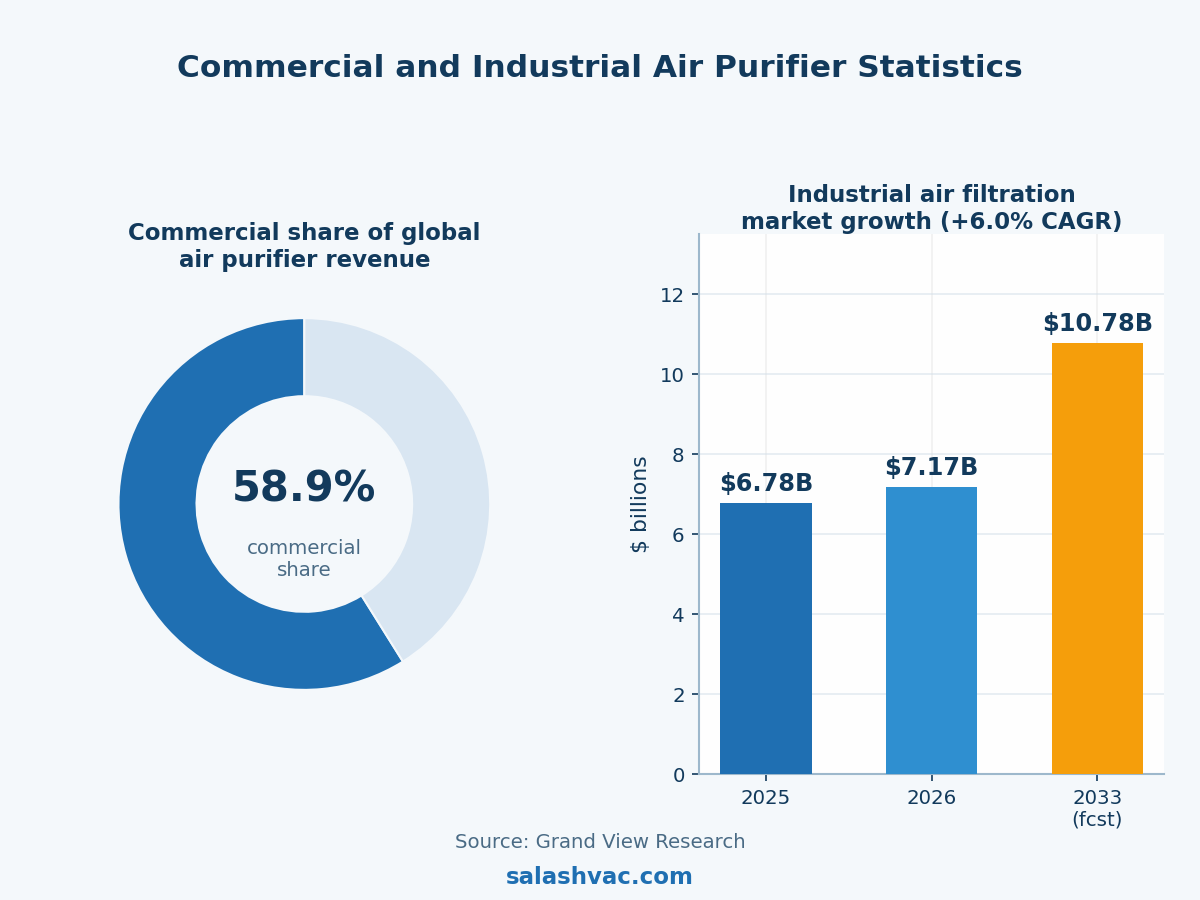
Commercial applications generate 58.9% of global air purifier revenue in 2025, the largest application share.
The separate industrial air filtration market was worth $6.78 billion in 2025 and will reach $10.78 billion by 2033 at a 6.0% CAGR according to Grand View Research.
Here are the headline numbers:
| Metric | Value |
|---|---|
| Commercial share of global air purifier revenue (2025) | 58.9% |
| Commercial share of U.S. air purifier market (2025) | 55.7% |
| Industrial air filtration market size (2025) | $6.78 billion |
| Industrial air filtration forecast (2033) | $10.78 billion |
| Industrial air filtration CAGR (2026 to 2033) | 6.0% |
| Industrial air purifiers market (2025, broader definition) | $6.17 billion |
| Industrial air purifiers forecast (2035) | $16.05 billion at 10.03% CAGR |
Note on definitions. Research firms draw the line between commercial and industrial segments differently. Grand View Research counts commercial applications inside the total air purifier market, while tracking industrial filtration as its own category.
The takeaway stays the same either way: business buyers, not homeowners, drive most of the revenue.
One research firm projects even faster growth for industrial air purifiers specifically.
Spherical Insights values that segment at $6.17 billion in 2025 and projects $16.05 billion by 2035, a 10.03% CAGR (Source: sphericalinsights.com).
Different research companies define these segments differently, so treat single numbers as ranges.
The direction, however, is consistent everywhere: going up.
Commercial Air Purifier Market Statistics
The commercial segment covers offices, schools, hospitals, hotels, malls, and public buildings. It leads the entire air purifier market.
Commercial buyers account for 58.9% of global revenue and 55.7% of U.S. revenue.
Offices, healthcare centers, and schools drive U.S. demand as they adopt stricter indoor air standards for occupant safety.
Building type matters here.
In-duct and fixed purification systems, the kind that integrate with central HVAC, grow at 5.4% globally and 5.8% in the U.S. through 2033.
Hospitals, offices, and public buildings lead that adoption.
This matters because commercial buyers think in systems, not gadgets. A hospital does not buy a plug-in unit. It specifies filtration inside the HVAC design itself.
The broader air filters market confirms the scale.
Fortune Business Insights values all air filters at $17.09 billion in 2025, growing to $34.67 billion by 2034 at 8.3% CAGR.
HEPA filters are the fastest growing filter type at 9.3% CAGR, and the commercial end user segment grows at 8.2% (Source: fortunebusinessinsights.com).
Industrial Air Filtration Market Statistics
Industrial filtration serves factories, cleanrooms, pharmaceutical plants, and food processing. The needs differ from commercial buildings, and so do the numbers.
North America dominates industrial air filtration with 41.9% of global revenue in 2025.
Strict workplace air regulations and a large manufacturing base explain that lead.
Look at how the industrial market splits according to grandviewresearch.com:
- Dust collection filters hold 41.7% of the market. Cement, metal, power, and wood processing plants rely on them.
- The aftermarket generates 78.8% of revenue. Filters wear out, so replacement and maintenance drive most spending.
- Filters rated above MERV 17 lead by rating with 36.7% share. Pharmaceutical, chemical, and clean manufacturing sites demand that level.
- HEPA filters are the fastest growing product at 6.6% CAGR. Cleanroom expansion in pharma, food, and electronics fuels that growth.
Semiconductor investment adds another tailwind. Cleanroom-grade filtration spending rides the wave of new chip fabrication plants in the U.S.
Which Commercial Sectors Spend the Most?
Commercial demand is not one market. It is several, each with its own reason to buy.
Offices buy purification to protect productivity and meet indoor air standards. Poor air links directly to fatigue, headaches, and irritation that drag down output (Source: grandviewresearch.com).
Healthcare facilities treat filtration as infection control. Hospitals specify HEPA or higher as a non-negotiable baseline in sensitive areas (Source: marketresearchfuture.com).
Schools got a federal push. The EPA’s November 2024 classroom guidance endorses HEPA-grade portable purifiers as a baseline intervention for K-12 buildings (Source: marketresearchfuture.com).
Hospitality and retail use purification to improve guest experience. Hotels, malls, and public buildings round out the commercial demand base (Source: fortunebusinessinsights.com).
Semiconductor and pharmaceutical construction adds an industrial crossover effect. New U.S. chip fabs channel billions into cleanroom-grade filtration infrastructure (Source: marketresearchfuture.com).
The Standards Driving Commercial Adoption
Regulations and standards now do what marketing never could. They make clean indoor air a requirement, not a perk.
ASHRAE Standard 241, published in 2023, is the first consensus standard for controlling infectious aerosols in buildings since the 1920s.
It sets minimum equivalent clean airflow rates per person, ranging from 10 to 45 liters per second depending on the space (Source: envigilance.com).
The practical impact is large:
- Classrooms need roughly 40 cubic feet per minute of equivalent clean airflow per person (Source: envigilance.com).
- Meeting Standard 241 can require up to 2.6 times more air changes in offices, 3 times more in schools, and 6 times more in healthcare settings than older ventilation baselines (Source: envigilance.com).
- Buildings can comply through ventilation, filtration (minimum MERV-A 11), air cleaning, or any mix of the three (Source: envigilance.com).
Schools get direct federal support too. The EPA finalized updated classroom air cleaning guidance in November 2024, endorsing HEPA-grade portable purifiers as a baseline intervention for K-12 schools (Source: marketresearchfuture.com).
Green building programs add pressure. LEED v4.1 requires MERV 13 or higher filtration media in commercial HVAC retrofits (Source: marketresearchfuture.com).
Wondering how these standards translate to your building? Our air cleaning services page explains the options for commercial spaces.
Why Businesses Invest: The Productivity and Health Data
Clean air pays for itself. The research behind that claim keeps getting stronger.
Improving indoor air quality boosted cognitive performance by as much as 61% in office testing. The Harvard COGfx study lowered VOCs and raised ventilation to achieve that result (Source: asthmaandallergyfriendly.com).
The exposure math explains why. Americans spend about 90% of their time indoors, where pollutant concentrations often run 2 to 5 times higher than outside. During activities like cooking or cleaning, indoor levels can spike to 100 times outdoor levels (Source: epa.gov).
For schools, poor air links directly to student performance and attendance. For offices, it shows up as fatigue, headaches, and lost output. Our indoor air quality statistics article covers the full health picture.
Pathogen control adds another layer. True HEPA filtration removes at least 99.97% of particles at 0.3 microns, the hardest size to capture (Source: epa.gov). For a closer look at virus-sized particles, read our analysis of whether HEPA filters remove viruses.
What These Statistics Mean for Facility Managers and Business Owners
Three lessons stand out from the 2026 data.
First, budget for filtration as infrastructure. The 78.8% aftermarket share proves that filters are an operating cost, not a one-time purchase. Plan replacement cycles into your budget from day one.
Second, design around standards, not minimums. ASHRAE 241 gives you a clear target in equivalent clean airflow per person. Buildings that meet it gain flexibility through mixed solutions: ventilation, filtration, and air cleaning.
Third, measure the return in people, not just air. A 61% cognitive performance gain dwarfs the cost of better filtration in almost any office budget. Clean air is a productivity investment.
Chemical pollutants deserve attention too. Particles are only half the story, and many buildings struggle with gases and VOCs. Our article on where VOCs hide in buildings maps the most common sources.
Arizona businesses that want a system designed around their building can talk to Salas HVAC, or any licensed commercial HVAC contractor in their region.
Breathe well,
James Mahoney
Co-Owner, Salas HVAC
FAQs
How big is the commercial air purifier market in 2026?
Commercial applications generate about 58.9% of the global air purifier market, which is worth an estimated $19.5 billion in 2026. That puts commercial revenue near $11.5 billion. The separate industrial air filtration market adds about $7.17 billion in 2026.
What is ASHRAE Standard 241?
ASHRAE Standard 241 (2023) sets minimum equivalent clean airflow rates per person to reduce airborne disease transmission in buildings. Requirements range from 10 to 45 liters per second per person depending on the space, and buildings can comply through ventilation, filtration, or air cleaning.
Which industries buy the most industrial air filtration?
Dust collection leads with 41.7% of the industrial market, driven by cement, metal, power, and wood processing. HEPA filters grow fastest at 6.6% CAGR thanks to pharmaceutical, food, and electronics cleanrooms.
Do air purifiers improve office productivity?
Yes. Harvard’s COGfx research found that better indoor air quality, achieved by lowering VOCs and improving ventilation, boosted cognitive performance by up to 61% in office environments.
How fast is the industrial air purifier market growing?
Industrial air filtration grows at 6.0% CAGR through 2033. Under a broader definition that includes all industrial air purifiers, Spherical Insights projects 10.03% annual growth from 2025 to 2035, taking the segment from $6.17 billion to $16.05 billion.
Are portable HEPA units enough for schools?
In many classrooms, yes. The EPA’s November 2024 guidance endorses HEPA-grade portable air cleaners as a baseline intervention for K-12 schools. Buildings with higher risk targets under ASHRAE 241 can combine portables with ventilation and HVAC filtration upgrades.
Why does the aftermarket dominate industrial filtration revenue?
Filters wear out. Replacement cycles, maintenance, and compliance checks generate 78.8% of industrial air filtration revenue. Facilities must service systems continuously to keep filtration efficiency and meet air quality rules.
What filter rating do commercial buildings need?
It depends on the goal. LEED v4.1 retrofits call for MERV 13 or higher. ASHRAE 241 sets a minimum of MERV-A 11 for infection risk management. Healthcare and cleanroom settings often require HEPA, rated at 99.97% removal of 0.3 micron particles.
Sources
- Air Filters Market Size, Share, Industry Report 2026-2034. Fortune Business Insights, August 2026. https://www.fortunebusinessinsights.com/industry-reports/air-filters-market-101676
- Air Purifier Market Size, Share & Trends Report, 2026-2033. Grand View Research, June 2026. https://www.grandviewresearch.com/industry-analysis/air-purifier-market
- Air Purifier Market Size, Share, Types, Trends, Report 2035. Market Research Future, August 2026. https://www.marketresearchfuture.com/reports/air-purifier-market-8148
- ASHRAE 241 Guide: ECAi Values, IRMM Triggers & Filtration. envigilance.com, April 2026. https://envigilance.com/compliance/ashrae-241/
- Breaking Down the Statistics: How Poor Indoor Air Impacts Daily Life. asthmaandallergyfriendly.com, October 2025. https://asthmaandallergyfriendly.com/USA/breaking-down-the-statistics-how-poor-indoor-air-impacts-daily-life/
- Indoor Air Quality. U.S. Environmental Protection Agency, May 2026. https://www.epa.gov/report-environment/indoor-air-quality
- Industrial Air Filtration Market Size & Share Report. Grand View Research, February 2026. https://www.grandviewresearch.com/industry-analysis/industrial-air-filtration-market
- Industrial Air Purifiers Market Insights Forecasts to 2035. Spherical Insights & Consulting, June 2026. https://www.sphericalinsights.com/press-release/industrial-air-purifiers-market
- Risk modeling for ASHRAE Standard 241-2023. Building and Environment, September 2025. https://www.sciencedirect.com/science/article/pii/S036013232500798X
- U.S. Air Purifier Market Size & Share, Industry Report 2033. Grand View Research, March 2026. https://www.grandviewresearch.com/industry-analysis/us-air-purifier-market
- What is a HEPA filter? U.S. Environmental Protection Agency, January 2026. https://www.epa.gov/indoor-air-quality-iaq/what-hepa-filter
- Why Indoor Air Quality is Important to Schools. U.S. Environmental Protection Agency, September 2025. https://www.epa.gov/iaq-schools/why-indoor-air-quality-important-schools