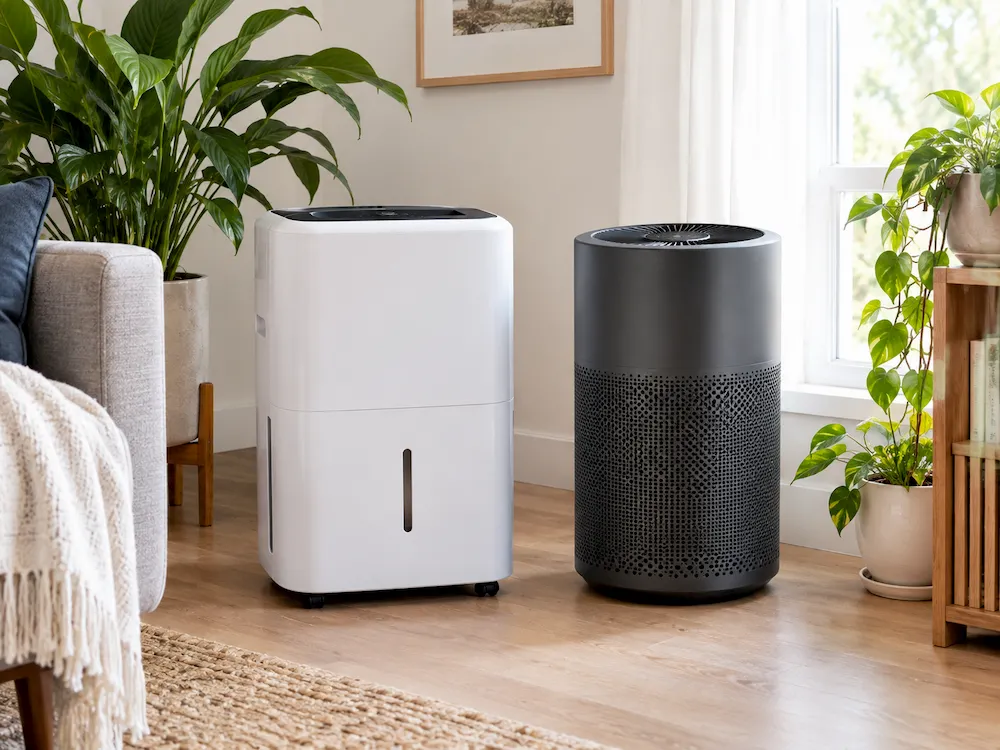
Dehumidifier vs air purifier: the answer depends on what is wrong with your air.
Many homes need both. We show you exactly what each device does, what it cannot do, and how to choose.
Key takeaways:
- Dehumidifier: removes water from air; fixes dampness, condensation, and musty odors
- Air purifier: filters particles; fixes dust, pollen, pet dander, smoke, and odors
- Target humidity: 30 to 50 percent indoors, per EPA guidance
- Buy a dehumidifier if: your basement smells musty or windows sweat
- Buy an air purifier if: allergies, dust, or odors bother you
- Both? Many homes run a dehumidifier downstairs and purifiers in bedrooms
Dehumidifier vs Air Purifier
A dehumidifier pulls moisture out of the air to stop mold, condensation, and musty smells.
An air purifier pulls air through filters to trap dust, pollen, dander, and smoke.
Pick a dehumidifier for dampness problems and an air purifier for particle and allergy problems.
What a Dehumidifier Actually Does
A dehumidifier draws room air over cold coils. Moisture condenses on the coils, drips into a tank or drain hose, and drier air flows back into the room. It removes water vapor only, not dust or allergens.
Why does that matter?
The EPA recommends keeping indoor humidity between 30 and 50 percent, because high humidity raises the concentration of some indoor pollutants and feeds mold growth.
The EPA’s mold guidance sets the red line even clearer: keep indoor humidity below 60 percent, ideally between 30 and 50 percent, to discourage mold.
A $10 humidity meter from any hardware store tells you where your home sits.
What a dehumidifier cannot do: it will not remove dust, pollen, pet dander, or smoke from your air. If your problem is particles, moisture control alone will not fix it.
What an Air Purifier Actually Does
An air purifier pulls air through layered filters and pushes cleaner air back out.
A true HEPA filter captures at least 99.97 percent of particles at 0.3 microns, which covers dust, pollen, mold spores, and pet dander.
Activated carbon layers handle odors and gases.
The EPA confirms that portable air cleaners can reduce indoor particle levels, especially when outdoor air quality is poor or ventilation is limited.
The same guide stresses one point buyers miss: filtration works on particles, not on moisture or humidity.
This matters because indoor air can be surprisingly dirty.
The EPA reports that indoor levels of some pollutants run 2 to 5 times higher than outdoor levels. A good purifier attacks that problem directly.
What a purifier cannot do: it will not lower humidity, dry a damp basement, or stop condensation on windows. Wet air needs moisture removal, not filtration.
Dehumidifier & Air Purifier: Side-by-Side
| Factor | Dehumidifier | Air purifier |
|---|---|---|
| Removes | Water vapor (moisture) | Dust, pollen, dander, smoke, odors |
| Solves | Dampness, condensation, musty smells, mold risk | Allergies, dust, pet hair, cooking smells, smoke |
| Cannot fix | Particles and allergens | Humidity and dampness |
| Best location | Basements, crawl spaces, laundry rooms | Bedrooms, living rooms, nurseries |
| Typical price | $150 to $350 for a 30-50 pint unit | $100 to $300 for a solid HEPA unit |
| Ongoing cost | Electricity; empty tank or run drain hose | Replacement filters every 6-12 months |
| Results you feel | Drier air within days | Less dust and fewer symptoms within days |
Signs You Need a Dehumidifier
Quick reality check first. Humidity problems concentrate in below-grade and poorly ventilated spaces, and they peak in late spring and summer.
If your symptoms show up every year around the same season, moisture is the likely driver.
Your home tells you when moisture is the problem. Watch for these signs:
- Musty smells in the basement, closets, or bathrooms
- Condensation on windows, walls, or cold water pipes
- Visible mold spots on ceilings, grout, or window frames
- Sticky, clammy air even when the temperature feels fine
- A humidity meter reading above 50 percent for days at a time
The EPA treats condensation on windows, walls, or pipes as a warning sign of excess indoor moisture and says to dry wet surfaces quickly.
A dehumidifier handles exactly this job.
Signs You Need an Air Purifier
Different symptoms, different machine. You need a purifier when particles are the problem:
- Allergy or asthma symptoms that ease when you leave the house
- Dust that returns a day after you clean
- Pet dander and hair floating in sunbeams
- Lingering odors from cooking, smoke, or bad smells that will not quit
- Wildfire smoke or outdoor pollution drifting into your area
One more signal: your own body.
Symptoms that fade at the office and return at home often trace back to indoor particles.
Can You Use a Dehumidifier and Air Purifier Together
Yes, and many homes should. The two machines solve different problems, so they complement rather than compete with each other.
A common setup: a dehumidifier runs in the basement where moisture collects, while purifiers run in bedrooms and living areas where you breathe the most. Run them together in the same room if that room has both damp air and dust.
Run the dehumidifier first when a room has both problems. Drier air helps the purifier work better, because damp particles clump and settle before the filter can catch them.
Once humidity holds under 50 percent, let the purifier carry the daily load.
One caution: do not place them touching each other. Give each unit open space on all sides so airflow stays strong. You need the correct air purifier placement for it to run efficiently.
What They Cost to Buy and Run
Both machines fit most budgets. A dependable 30-50 pint dehumidifier costs $150 to $350. A solid HEPA air purifier for one room costs $100 to $300, and our air purifier cost guide breaks that down by size and feature.
Running costs differ. A dehumidifier draws more power, similar to a small window AC, and needs its tank emptied or a drain hose attached. A purifier sips electricity but needs new filters every 6 to 12 months, usually $30 to $80 per set.
Think in yearly terms, not sticker price. A $200 purifier plus $60 a year in filters costs about $320 over two years. A $250 dehumidifier plus roughly $10 to $15 a month in summer electricity lands in the same range. Neither machine is a budget breaker.
Skip the gimmicks at either price point.
For purifiers, a true HEPA filter and a carbon layer matter more than apps and touchscreens.
For dehumidifiers, capacity matched to your room size matters more than extra features.
How Each Device Affects Your Health
Moisture control and particle control protect you in different ways. Damp air feeds mold and dust mites, two of the most common indoor allergy triggers. Filtering the air removes the particles that reach your lungs.
If someone in your home has asthma, watch both numbers: the humidity reading and the dust level. High humidity lets dust mites multiply, while airborne dander and pollen irritate airways directly.
The latest indoor air quality statistics shows how common these triggers are in American homes.
For everyday comfort, the target is simple.
Keep humidity in the 30 to 50 percent window and keep particles low with filtration. One machine handles the first job. The other handles the second.
Which Device Goes Where
Match the machine to the room’s issue.
- Basement: dehumidifier, almost always. Below-grade rooms collect moisture from soil and cool surfaces.
- Bedroom: air purifier, unless the room smells musty or windows sweat overnight.
- Bathroom: neither at first. Run the exhaust fan during showers. Add a small dehumidifier only if dampness lingers.
- Living room: air purifier, especially with pets, carpets, or heavy cooking nearby.
- Laundry room: dehumidifier if the dryer and washer push humidity up.
- Nursery: air purifier with a true HEPA filter, placed away from the crib.
How to Size Correctly
Undersizing is the number one buyer mistake for both devices.
For dehumidifiers, match pint capacity to the space and its dampness. A 30-pint unit handles a mildly damp room up to about 1,500 square feet.
A 50-pint unit suits wet basements and larger spaces. When in doubt, size up, because a bigger unit reaches the target faster and cycles off.
For air purifiers, match the CADR rating to your room. CADR (Clean Air Delivery Rate) tells you how much filtered air the unit moves per minute.
A simple rule: pick a CADR at least two-thirds of your room’s square footage. A 300-square-foot bedroom wants a CADR of 200 or more.
Both ratings appear on the box. Spend two minutes on them and you avoid the most common return reason.
Noise and Energy
Dehumidifiers hum like a small refrigerator and add noticeable warmth to a room. In summer that is a fair trade for dry air. In a bedroom, the compressor noise bothers light sleepers.
Air purifiers run quieter on low and medium settings, roughly like a desk fan. Energy draw stays modest, often less than a laptop charger on low speed.
Either way, check the decibel rating if the machine will run where you sleep. Under 50 decibels disappears into background noise for most people.
Maintenance That Keeps Both Machines Working
Both devices fail quietly when neglected. A dirty filter or a slimy tank turns a helpful machine into a pollutant source.
For dehumidifiers, empty and rinse the tank weekly, and wash the tank with mild soap monthly to stop bacteria and mold from growing inside it.
Vacuum the intake grille every few weeks. If your model has a filter, rinse it on the schedule in the manual.
For purifiers, replace the HEPA filter every 6 to 12 months and the carbon pre-filter more often if you cook daily or own pets.
Most units show a filter light. Treat it as a deadline, not a suggestion.
Common Mistakes Buyers Make
- Buying a purifier for a damp basement. Filters cannot remove moisture. The musty smell returns within a week.
- Buying a dehumidifier for allergies. Drier air helps, but dust and pollen still float. You need filtration.
- Undersizing the machine. Match dehumidifier pints and purifier CADR ratings to your room size.
- Ignoring the humidity meter. A $10 hygrometer ends the guessing. Buy one before you buy anything else.
- Running a dehumidifier in winter. Cold-season air rarely needs drying. Store it until spring humidity returns.
FAQs
Which is better for mold: a dehumidifier or an air purifier?
A dehumidifier prevents mold by keeping humidity below the growth threshold. An air purifier captures airborne mold spores but cannot stop new growth on damp surfaces. For an active mold problem, control moisture first, then filter the air.
Which one helps with allergies?
An air purifier, because allergens like pollen, dander, and dust mite debris are particles that HEPA filters trap. A dehumidifier helps indirectly: dust mites struggle to survive below 50 percent humidity, so very damp homes benefit from both machines.
Should I put a dehumidifier or air purifier in my bedroom?
Most bedrooms need a purifier, not a dehumidifier. Bedrooms rarely run humid, and quiet filtration helps with sleep and nighttime allergies. Choose the dehumidifier only if your bedroom window sweats or smells musty.
Do I need a whole-house unit or portable units?
Start portable. A $250 dehumidifier in the basement and a $150 purifier in the bedroom solve most home air problems for under $400. Whole-house systems make sense when humidity or air quality problems cover every room.
Can a dehumidifier cool a room like an air conditioner?
No. A dehumidifier actually adds a little heat while it dries the air. Drier air feels cooler on your skin, but the room temperature does not drop.
Can one combo unit do both jobs?
Combo dehumidifier-purifier units exist, and they work for mild cases of both problems. The trade-off is capacity: a combo unit dries and filters less air than two dedicated machines.
Sources
- U.S. Environmental Protection Agency. “A Brief Guide to Mold, Moisture and Your Home.”
https://www.epa.gov/mold/brief-guide-mold-moisture-and-your-home - U.S. Environmental Protection Agency. “Care for Your Air: A Guide to Indoor Air Quality.”
https://www.epa.gov/indoor-air-quality-iaq/care-your-air-guide-indoor-air-quality - U.S. Environmental Protection Agency. “Guide to Air Cleaners in the Home.”
https://www.epa.gov/indoor-air-quality-iaq/guide-air-cleaners-home - U.S. Environmental Protection Agency. “Indoor Air Quality (Report on the Environment).”
https://www.epa.gov/report-environment/indoor-air-quality