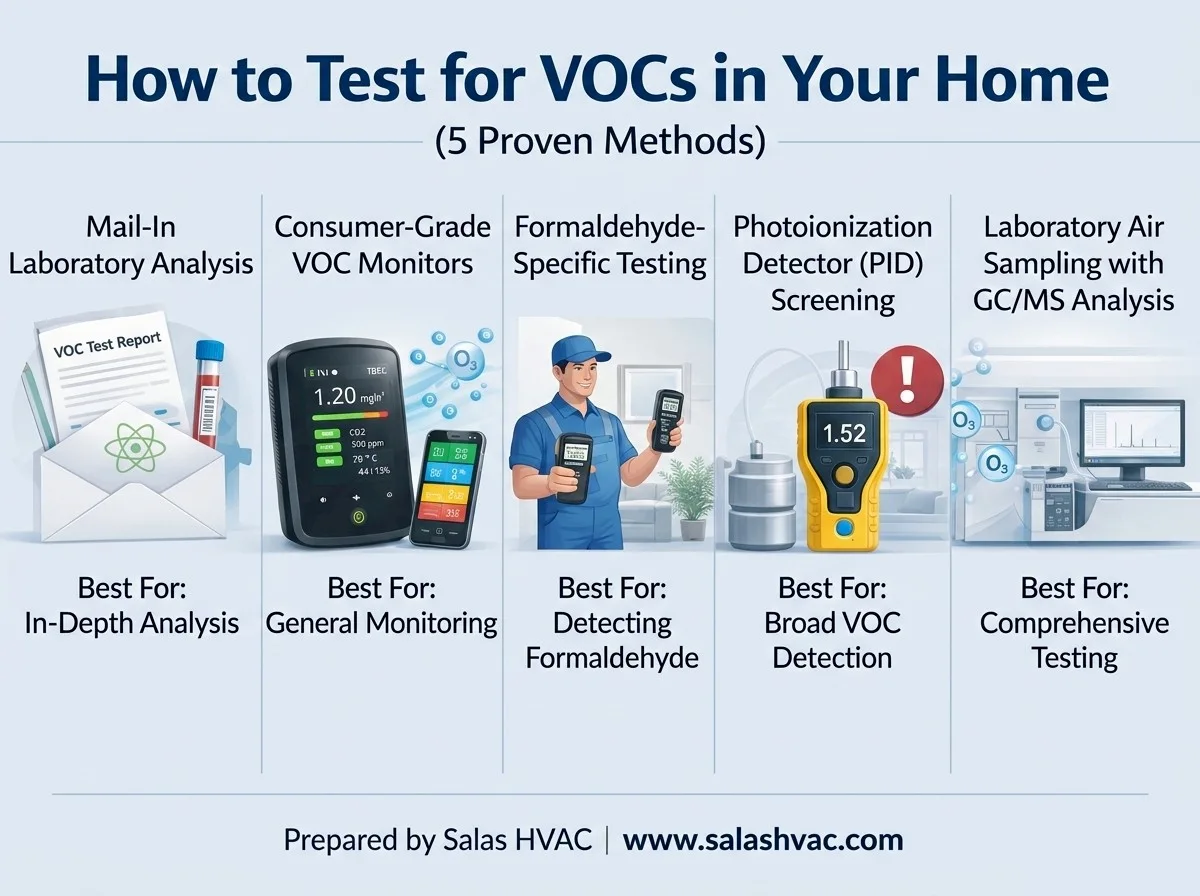
Our service data shows that homes built or renovated within the last five years frequently contain VOC levels up to five times higher than outdoor air. The problem is not just knowing that VOCs exist. It is knowing exactly how to measure them accurately without wasting money on useless gadgets.
Testing for VOCs is not a single procedure. It is a tiered system ranging from $30 DIY kits to sophisticated laboratory analysis costing over $1,000. Each method serves different purposes, delivers different data quality, and suits different situations. We break down every legit VOCs testing option available to homeowners in 2026, what results actually mean, and how to act on them.
Why Testing for VOCs Matters
Most homeowners assume they would smell dangerous chemicals. That assumption is wrong. Many VOCs are odorless at concentrations that still trigger health effects.
Others create smells so subtle that your nose adapts within minutes, rendering you effectively blind to their presence.
The health impact spectrum ranges from immediate irritation to long-term disease. Short-term exposure to elevated VOC levels causes headaches, dizziness, throat irritation, and eye discomfort.
Long-term exposure to specific compounds like formaldehyde or benzene is classified as carcinogenic. Children, pregnant women, and individuals with respiratory conditions face heightened vulnerability.
Testing becomes critical after specific triggering events.
New flooring, cabinetry, furniture, paint, or insulation introduce concentrated VOC loads that off-gas for weeks to months.
Renovation projects, especially those involving spray foam insulation or composite wood products, create temporary spikes that can exceed safe thresholds by tenfold or more.
How to Test for VOCs in Your Home: DIY Testing Methods
DIY VOC testing is the entry-level tier. These methods work best for screening, establishing baselines, or monitoring changes over time.
They do not deliver the specificity or accuracy of professional analysis, but they provide actionable data when used correctly.
Home Air Quality Test Kits: Mail-In Laboratory Analysis
Mail-in test kits represent the most accurate DIY option available. These kits typically cost between $80 and $200 and use legitimate laboratory analysis methods.
The process involves collecting an air sample using a passive diffusion badge or active pump sampler, then shipping the sample to a certified lab for analysis.
The technology behind these kits is sound. Most use sorbent tubes filled with Tenax TA or carbon-based adsorbents that trap VOCs from the air over a defined period, usually 24 to 72 hours.
Laboratories analyze these samples using thermal desorption paired with gas chromatography and mass spectrometry (GC/MS). This method identifies individual VOC compounds and quantifies their concentrations down to microgram-per-cubic-meter levels.
When purchasing a kit, verify that the laboratory holds ISO 17025 accreditation or equivalent certification. Non-accredited labs may use inferior methods or provide unverifiable results.
Also confirm that the kit tests for formaldehyde separately, as formaldehyde requires different collection methods (typically DNPH-coated cartridges analyzed by HPLC) than general VOC screening.
Limitations exist.
One-time snapshots may miss temporal variations. VOC levels fluctuate based on temperature, humidity, ventilation rates, and recent activities like cooking or cleaning.
A single sample taken on a cold winter day with windows closed will differ dramatically from summer conditions with natural ventilation.
Consumer-Grade VOC Monitors
Consumer monitors priced from $30 to $300 offer continuous real-time readings. These devices appeal to homeowners wanting ongoing awareness rather than one-time snapshots. However, understanding their limitations prevents false confidence.
Most consumer devices use metal oxide semiconductor (MOS) sensors. These sensors detect VOCs through chemical reactions that change electrical resistance.
The main problem is selectivity. MOS sensors cannot distinguish between different VOC compounds. They provide a total VOC (TVOC) reading without identifying whether your air contains harmless ethanol from hand sanitizer or carcinogenic benzene from vehicle exhaust.
Accuracy varies wildly.
Professional-grade photoionization detectors costing $6,000+ provide reliable TVOC screening. Consumer devices using $10 sensors deliver readings that indoor air quality professionals consider unreliable for decision-making.
Temperature and humidity fluctuations cause drift. Calibration standards are often nonexistent.
Use consumer monitors as early warning systems only. If readings spike consistently, escalate to mail-in kits or professional testing.
Do not trust these devices for health-critical decisions or for validating that remediation efforts succeeded.
Professional VOC Testing
Professional VOC testing becomes necessary when health symptoms exist, when real estate transactions require documentation, or when DIY results show concerning levels that need verification.
Professionals bring calibrated instrumentation, standardized protocols, and interpretive expertise that DIY methods cannot match.
Photoionization Detector (PID) Screening
PID screening offers the fastest professional assessment. A trained technician uses a handheld device that ionizes VOC molecules using ultraviolet light, measuring the resulting electrical current to estimate total VOC concentration. The entire home survey takes one to two hours.
PIDs excel at spatial mapping. Technicians can compare room-to-room variations, identify hotspot locations, and track how levels change with ventilation adjustments.
Data logs continuously, revealing temporal patterns invisible to snapshot methods.
The limitation is specificity. Like consumer MOS sensors, PIDs measure total ionizable compounds without identifying individual chemicals.
A PID cannot distinguish between acetone from nail polish remover and toluene from paint thinner. PIDs also miss formaldehyde entirely, as formaldehyde requires higher ionization energy than standard PIDs provide.
PID screening works best as a first-pass investigation. It identifies whether elevated VOC levels exist and where they concentrate. For chemical identification, laboratory sampling becomes necessary.
Laboratory Air Sampling with GC/MS Analysis
Professional laboratory sampling represents the gold standard for VOC identification and quantification.
This method follows EPA TO-15 or TO-17 protocols, collecting air samples into SUMMA canisters or onto thermal desorption tubes for comprehensive analysis.
The sampling process involves placing calibrated pumps with sorbent tubes in representative locations throughout your home.
Collection periods range from eight hours to several days depending on the investigation scope. Samples then undergo thermal desorption and analysis by gas chromatography-mass spectrometry (GC/MS).
GC/MS identifies individual VOC compounds with specificity that screening tools cannot approach.
The analysis detects hundreds of specific chemicals, quantifies each concentration, and compares results against health-based exposure guidelines from OSHA, EPA, and other regulatory bodies.
This specificity matters because different VOCs carry vastly different toxicity profiles. Knowing you have 500 micrograms per cubic meter of ethanol tells a completely different story than 500 micrograms per cubic meter of benzene.
Professional interpretation adds value beyond raw numbers. Experienced analysts can correlate detected compounds with likely sources. Elevated 1,4-dichlorobenzene suggests mothball use.
High levels of styrene point to certain plastics or fiberglass. This source identification guides targeted remediation rather than generic “air out the house” advice.
Formaldehyde-Specific Testing Methods
Formaldehyde deserves special attention because it is the most common and well-studied indoor VOC, yet standard TVOC methods often miss it. Formaldehyde testing requires specialized collection and analysis.
The EPA Method TO-11A protocol uses DNPH-coated cartridges that react specifically with formaldehyde to form a stable derivative. High-performance liquid chromatography (HPLC) then quantifies the derivative with precision.
Passive diffusion badges offer a simpler alternative for formaldehyde.
These badges hang in your home for 24 to 72 hours, allowing formaldehyde to diffuse onto a collection medium. They are then mailed to laboratories for analysis. Cost ranges from $50 to $150 per sample.
Formaldehyde testing is particularly important in homes with new composite wood products, recent insulation work, or persistent unexplained irritation symptoms.
The EPA notes that formaldehyde concentrations in new homes can exceed 100 micrograms per cubic meter, well above the 30 micrograms per cubic meter level associated with sensory irritation in sensitive individuals.
How to Choose the Right VOCs Testing Method
Selecting the appropriate VOCs testing method depends on your specific circumstances, budget, and information needs.
- Choose DIY mail-in kits when: You want baseline data, recently completed minor renovations, or need to verify that consumer-grade monitor readings warrant further investigation. Budget $100–$200 per sample location.
- Choose professional PID screening when: You need rapid spatial mapping, suspect specific rooms have problems, or want to evaluate how ventilation changes affect levels. Budget $300–$600 for whole-home screening.
- Choose professional laboratory sampling when: Occupants experience unexplained health symptoms, you need documentation for real estate or legal purposes, or DIY results show concerning levels requiring verification. Budget $500–$1,500 depending on sample count and analysis depth.
- Choose formaldehyde-specific testing when: You have new composite wood products, recent spray foam insulation, or symptoms consistent with formaldehyde exposure (eye/throat irritation, respiratory issues). Budget $50–$300 depending on method.
Consider timing carefully. Testing immediately after painting or installing new flooring captures peak emissions that may not represent long-term conditions.
Testing after 30 to 90 days of occupancy provides more realistic exposure data. For new construction, test at move-in, then again at six months and one year to track off-gassing decay.
Understanding Your VOC Test Results
Interpreting VOC results requires context. Unlike drinking water or food safety, no federal enforceable standards exist for indoor VOC concentrations. Instead, multiple organizations publish guidelines based on health research.
The EPA and Lawrence Berkeley National Laboratory compile exposure guidelines from OSHA, WHO, and research institutions.
- For formaldehyde, the EPA uses 30 parts per billion (ppb) as a level protective against sensory irritation.
- For total VOCs, European standards often reference 200–300 micrograms per cubic meter as a target range for non-industrial spaces.
Professional reports should compare your results against these guidelines. Ask your testing provider specifically which benchmarks they use and why.
Be wary of companies that provide numbers without interpretation or that use arbitrary “good/bad” scales without referencing established health standards.
Pattern analysis often matters more than absolute numbers. A single elevated reading of xylene on a day when you were painting may be less concerning than moderate but persistent levels of multiple compounds over months.
Look for trends, multiple detections of related compounds suggesting specific sources, and concentrations that exceed guidelines by significant margins.
What to Do After You Get Your Results
Elevated VOC levels do not necessarily require expensive remediation. Often, simple interventions deliver significant improvements.
1. Source removal is priority
Identify and eliminate the products emitting VOCs. This may mean returning that new rug, switching to low-VOC cleaning products, or properly sealing composite wood furniture. Our VOC source guide helps identify common culprits.
2. Increase Ventilation
Increasing outdoor air exchange dilutes indoor VOC concentrations. Open windows when weather permits. Run exhaust fans. Consider a mechanical ventilation system or energy recovery ventilator (ERV) for continuous fresh air supply without energy penalty.
3. Air cleaning with activated carbon filters
HEPA filters remove particles but do nothing for gases. Only activated carbon or similar sorbent media adsorb VOCs. Place carbon filter air purifiers in rooms with elevated levels. Size the unit appropriately for the room volume and change filters per manufacturer schedules.
4. Temperature and humidity control
Higher temperatures accelerate VOC release from materials. Keeping indoor temperatures moderate, especially in storage areas with VOC-emitting products, reduces emission rates. Maintain humidity between 30% and 50% to minimize both off-gassing and mold growth.
Retest after implementing changes. Wait at least two weeks after interventions, then use the same testing method to measure improvement. This validation step confirms whether your efforts worked or whether professional remediation is necessary.
FAQs
Can I trust a $50 VOC monitor from Amazon?
Consumer monitors using metal oxide semiconductor sensors provide approximate trend data but lack the accuracy for health decisions. Use them as early warning systems only. If readings consistently show elevated levels, verify with mail-in laboratory kits or professional testing before investing in major remediation.
How long should I wait to test after painting or installing new flooring?
Test twice: first at 72 hours post-installation to capture peak emissions, then again at 30 days to assess sustained levels. Peak testing identifies whether immediate ventilation is critical. The 30-day test reveals whether long-term exposure concerns exist as materials continue off-gassing.
What is the difference between TVOC and individual VOC testing?
TVOC (total volatile organic compounds) provides a single number representing the sum of all detectable VOCs. Individual VOC testing identifies specific chemicals. TVOC screening is faster and cheaper but tells you nothing about toxicity.
How often should I test for VOCs in a new home?
Test at move-in, then at six months and one year. New construction and recent renovations release the highest VOC loads during the first six months as materials off-gas. After one year, test every two to three years or after any major renovation, new furniture purchases, or if occupants develop unexplained symptoms.
Breathe easy,
Michael
Sources
- Indoor Science. “Volatile Organic Compounds Testing.” 2025.
https://indoorscience.com/what-we-do/indoor-air-quality/vocs/ - PMC. “Volatile Organic Compounds in Indoor Air: Sampling and Analysis.” 2025.
https://pmc.ncbi.nlm.nih.gov/articles/PMC12115474/ - U.S. Environmental Protection Agency. “Indoor Air Exposure Assessment for Formaldehyde.” December 2024.
https://www.epa.gov/system/files/documents/2025-01/22.-formaldehyde-.-indoor-air-exposure-assessment-.-public-release-.-hero-.-dec-2024.pdf - U.S. Environmental Protection Agency. “Method TO-11A: Determination of Formaldehyde in Ambient Air.” 2020.
https://www.epa.gov/sites/default/files/2019-11/documents/to-11ar.pdf - U.S. Environmental Protection Agency. “Volatile Organic Compounds’ Impact on Indoor Air Quality.” 2025.
https://www.epa.gov/indoor-air-quality-iaq/volatile-organic-compounds-impact-indoor-air-quality