Shopping for an air purifier means facing a price range that spans from $50 to over $12,000. The short answer is most effective portable units cost between $100 and $900 and above $1,000, while whole-house systems average $2,610 installed.
Your actual cost depends on what type of air purifier you need, how large a space you’re covering, and what pollutants you want removed. We found several affordable purifiers that outperform expensive ones, and we’ll show you exactly where your money should go.
2026 Air Purifier Costs
Not all air purifiers work the same way or carry the same price tag.
Your two main options are portable units and whole-house systems integrated with your HVAC.
1. Portable Air Purifier Cost
Portable air purifiers plug into any outlet and clean air in specific rooms. These are what most people buy for homes and offices.
“In our internal testing, solid portable air purifiers ran between $200 and $900, with most of the reliable mid-range options clustering around $300 to $500.”
Michael Salas
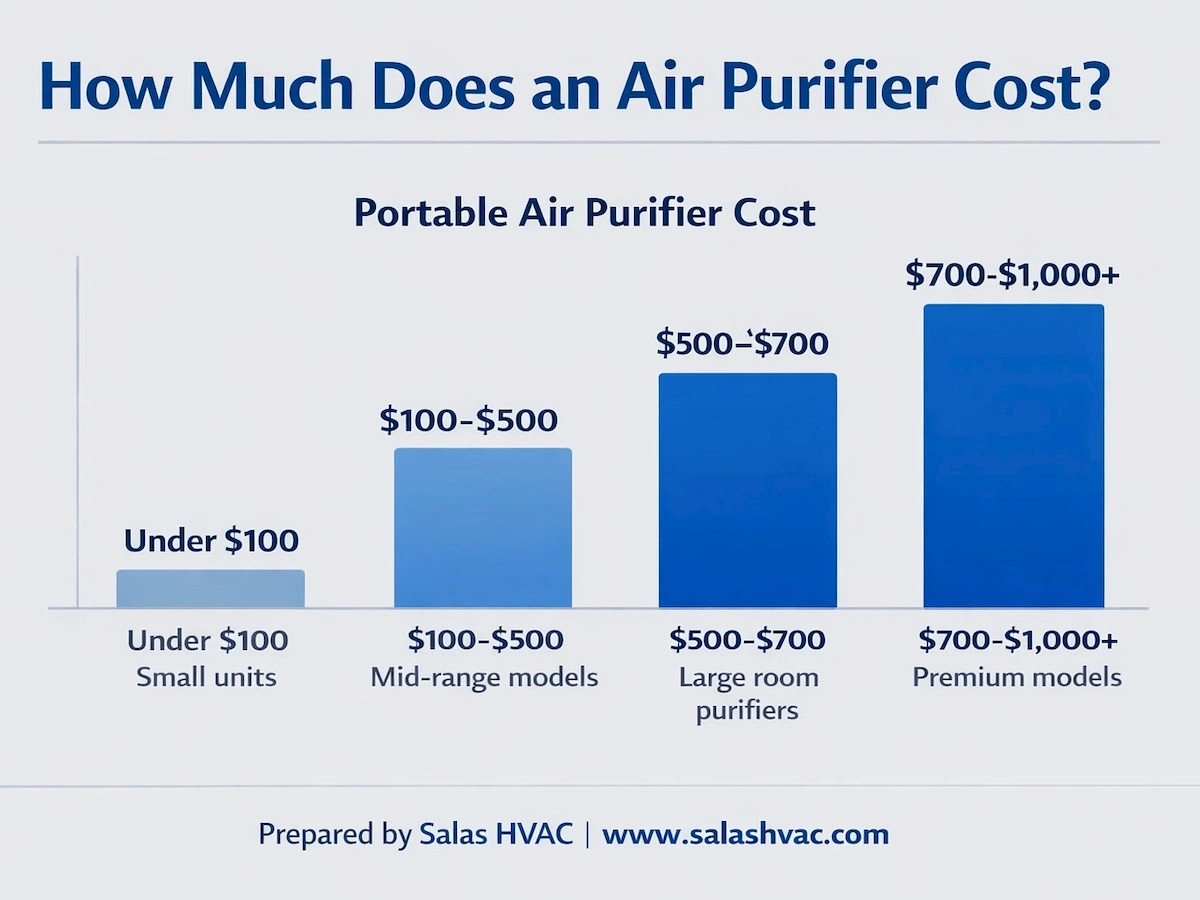
Here’s what you’ll pay:
- Under $100: Small units covering 150-200 sq ft with basic filtration
- $100-$500: Mid-range models for 300-500 sq ft with HEPA and carbon filters
- $500-$700: Large room purifiers covering 700-1,000 sq ft with smart features
- $700-$1,000+: Premium models with medical-grade HEPA and heavy carbon loads
The Winix A231 sits at the budget end ($80) but delivers 154 CFM performance that rivals $200 competitors.
The Levoit Core 300 holds strong at $100 with proven reliability and generic filter availability.
2. Whole-House Air Purification Systems Cost
Whole-house systems integrate with your existing ductwork to filter air throughout your home.
Installation requires professional HVAC work.
Cost breakdown:
- Flat filters: $50-$170 installed
- Extended media filters: $400-$800 installed
- Electronic filters: $500-$2,000 installed
- UV light systems: $750-$3,500 installed
- HEPA systems: $2,000-$5,000+ installed
The national average for whole-house installation is $2,610, with most homeowners spending between $419 and $4,962.
HVAC labor runs $100-$250 per hour, and installations take 1-6 hours depending on complexity and duct accessibility.
What Affects Air Purifier Pricing?
Five factors drive the sticker price on any air purifier you’re considering.
Filter Type and Technology
- True HEPA filters capture 99.97% of particles down to 0.3 microns. Units with genuine HEPA certification cost more than “HEPA-type” alternatives that use looser standards.
- Activated carbon filters remove odors and volatile organic compounds. More carbon means better gas removal and higher prices. Budget units might include a thin carbon layer, while premium models pack several pounds of activated carbon.
- Specialty filters like UV-C lights for killing bacteria or ionizers for charged particle removal add $100-$500 to the base price.
Room Size Coverage
Manufacturers rate air purifiers by square footage coverage. Bigger coverage areas require larger fans, more powerful motors, and bigger filters. This pushes prices up.
A 200 sq ft bedroom unit costs $80-$150. A 1,000 sq ft living room model runs $300-$700. Pay attention to the Clean Air Delivery Rate (CADR) number, not just room size claims.
Smart Features and Sensors
Air quality sensors add $50-$150 to the cost but let your purifier adjust fan speed automatically. App connectivity, voice control, and scheduling features typically appear on units above $150.
The Levoit Core 300 ($100) performs like the Core 300S ($150) but lacks smart features.
Cost of Budget vs Premium Air Purifiers
Your spending bracket determines what features and performance you get. Here’s what each tier delivers.
Entry-Level Units Under $100
Most sub-$100 air purifiers struggle with anything larger than a small bedroom. Many use “HEPA-type” filters instead of true HEPA and skip carbon filtration entirely.
Exception: The Winix A231 at $79.99 offers legitimate 226 CFM performance with a four-stage filtration system including true HEPA, carbon, and PlasmaWave technology.
Skip anything under $50. These devices barely improve air quality and waste your money.
Mid-Range Options $200-$400
This sweet spot gets you solid performance with HEPA and carbon filtration for medium to large rooms. Many include air quality sensors and auto modes.
You’ll find reliable brands like Levoit, Coway, and Winix here.
Expect 250-400 CFM output and coverage for 400-800 sq ft spaces. Filter costs stay reasonable at $50-$80 per year.
High-End Models $500+
Premium units like the Austin Air HealthMate ($850+) excel at VOC removal with massive carbon filters.
The IQAir HealthPro Plus XE Air Purifier ($1,000+) provides medical-grade HyperHEPA filtration but costs more to run due to expensive replacement filters.
High-end purifiers make sense if you’re dealing with serious odor issues, chemical sensitivities, or need hospital-grade air cleaning. For typical home use, mid-range models deliver 90% of the performance at half the price.
Filter Replacement Costs
The sticker price is just your first payment. Replacement filters create ongoing expenses that often exceed the initial purchase over 3-5 years.
HEPA Filter Expenses
HEPA filters need replacement every 6-12 months depending on usage and air quality in your home. Replacement costs vary widely by brand:
- Budget models: $20-$40 per filter
- Mid-range units: $40-$80 per filter
- Premium brands: $80-$200 per filter
Some manufacturers like Levoit and Winix offer affordable generic alternatives. IQAir and other premium brands require expensive OEM filters that can’t be substituted.
Running an air purifier 24/7 in a high-pollution area (pets, smoking, urban location) shortens filter life to 6-9 months. Clean suburban homes might stretch HEPA filters to 12-15 months.
Carbon Filter Frequency
Activated carbon filters saturate faster than HEPA filters because they absorb gases and odors until the carbon pores fill up. Replace these every 3-6 months.
Carbon filter costs:
- Standard carbon sheets: $15-$30
- Thick carbon layers: $30-$50
- Heavy pelletized carbon: $50-$100
Many affordable units bundle HEPA and carbon filters together. You’ll buy multiple combo packs per year even though you only need one HEPA filter annually.
This bundling strategy inflates long-term costs. Look for units that sell filters separately or offer washable pre-filters to extend carbon filter life.
Annual Operating Costs
Add up purchase price, filters, and electricity to see your true yearly expense.
Energy Consumption
Air purifiers run 24/7 for best results. Energy Star certified models use 40% less electricity than standard units and save about $30 per year.
Most portable units draw 30-70 watts on medium speed. At average US electricity rates, that’s $20-$50 annually. Small bedroom units on low speed might cost only $10 per year to run.
Whole-house systems tap into your HVAC blower, adding $50-$150 to annual energy bills depending on system size and runtime.
Total First Year vs Long-Term
Calculate your real investment by projecting 5-year costs:
| Item | Year 1 | Years 2-5 (Annual) | 5-Year Total |
| Budget Unit ($100) | $100 + $60 filters + $30 energy | $60 filters + $30 energy | $550 |
| Mid-Range ($300) | $300 + $80 filters + $40 energy | $80 filters + $40 energy | $780 |
| Premium ($700) | $700 + $150 filters + $50 energy | $150 filters + $50 energy | $1,500 |
These numbers assume proper filter maintenance.
Skipping filter changes costs more in the long run because dirty filters force motors to work harder, consuming more electricity and shortening the unit’s lifespan.
How to Save Money on Air Purifiers in 2026
Smart shopping cuts your costs without sacrificing clean air.
- Buy during sales. Air purifier prices drop 20-30% during Black Friday, Amazon Prime Day, and seasonal transitions. Set price alerts for models you’re tracking.
- Choose generic filters. Many popular models have compatible third-party filters costing 30-50% less than OEM replacements. Verify they meet true HEPA standards before buying.
- Size correctly. Don’t overbuy coverage. A properly sized unit on higher speed outperforms an oversized unit on low speed while costing less upfront and in filter replacements.
- Check filter bundling. Units that sell HEPA and carbon filters separately save money long-term compared to forced combo packs.
- Skip unnecessary features. Wi-Fi connectivity and app control add cost without improving air cleaning. Stick with manual controls if you don’t need remote operation.
- Consider washable pre-filters. These extend the life of your main filters by 2-3 months, reducing replacement frequency.
- Focus on core performance metrics like CADR rating, true HEPA certification, and reasonable long-term filter costs over fancy features that don’t affect air quality.
FAQs
How much should I spend on an air purifier?
Budget $150-$300 for reliable performance in most homes. Spend $80-$100 only if you’re covering a small bedroom. Invest $400-$700 for large spaces, severe allergies, or heavy odor removal needs.
What’s the cheapest air purifier that actually works?
The Winix A231 ($80) delivers legitimate performance with true HEPA filtration and 226 CFM output. Below this price point, most units lack the motor power and filter quality to meaningfully improve air quality.
Are expensive air purifiers worth it?
Premium models excel at specific tasks like VOC removal or medical-grade particle filtration. For general home use removing dust, pollen, and pet dander, mid-range units ($200-$400) provide excellent results at lower total cost.
How much does it cost to run an air purifier per month?
Most portable units cost $2-$5 monthly in electricity when running continuously. Energy Star certified models on low to medium speed typically add less than $20 to annual utility bills.
How long do air purifiers last?
Quality units run 5-10 years with proper maintenance. The motor and housing last longer than you’ll own most appliances. Filter replacement is your main ongoing expense, not unit replacement.
What’s the best value air purifier?
The Levoit Vital 100S ($120-$150) balances strong performance, smart features, and affordable filter replacements. It covers spaces up to 220 sq ft with 4.8 air changes per hour.
Breathe easy,
Michael
Sources
Angi. “How Much Does a Whole House Air Purifier Cost? [2025 Data].” October 28, 2025. https://www.angi.com/articles/whole-house-air-purifier-cost.htm
Blueair. “Air Purifier Filter Replacement Cost & Frequency Guide.” 2025.
https://www.blueair.com/blogs/news/air-purifier-filter-replacement-frequency
Consumer Reports. “Air Purifier Buying Guide.” July 31, 2025.
https://www.consumerreports.org/appliances/air-purifiers/buying-guide/
HomeAdvisor. “How Much Does a Whole-Home Air Purifier Cost? (2025).” 2025.
https://www.homeadvisor.com/cost/cleaning-services/install-a-central-air-cleaner/
Life Supply USA. “Why You Must Replace Air Filters Frequently.” April 11, 2022. https://lifesupplyusa.com/blogs/news/air-filters-maintenance-why-you-must-replace-filters-frequently