
Jump to >> Best Overall | Heavy VOCs Option | Large Spaces | Smart Option | Budget Option | Buying Guide | How We Test | FAQs
The term ‘VOC’ stands for volatile organic compounds, gases that contain various chemicals, many of which pose serious risks to your health and indoor air quality. As an HVAC company co-owner who’s been in this industry for over two decades, I’ve seen firsthand how VOCs impact families, especially those with respiratory sensitivities or chemical intolerances.
Many VOCs are human-made chemicals used in pharmaceuticals, paints, refrigerants, and industrial processes. They’re also created through water treatment chlorination and found in pesticides, building materials, and fuel sources. What most homeowners don’t realize is how these gases infiltrate everyday life.
These chemicals enter your home through common household products: paints, cleaning supplies, beauty products like perfumes and nail polish, air fresheners, and even that “new furniture” smell everyone loves. In commercial settings, printers and photocopiers are major VOC emitters.
According to the U.S. Environmental Protection Agency, VOC concentrations can be up to ten times higher indoors than outdoors. Outside, VOCs dissipate naturally. Indoors, they accumulate, and that’s where the health problems begin.
I’ve consulted with hundreds of clients experiencing symptoms they couldn’t explain: ongoing headaches, throat irritation, fatigue, and respiratory issues. Time and again, elevated indoor VOC levels were the culprit. Long-term exposure can lead to kidney damage, liver problems, and even certain cancers.
If you’re short on time, here’s my quick-reference comparison table based on hands-on testing and real-world client feedback:
| BEST OVERALL | HEAVY VOCs OPTION | LARGE ROOM OPTION | SMART OPTION | BUDGET OPTION | |
|---|---|---|---|---|---|
| Model | Austin Air HealthMate Plus | IQAir HealthPro Compact XE | Coway Air Purifier ProX | Coway Airmega AP-1512HHS MightyS | Levoit Core 600S-P |
| Image | 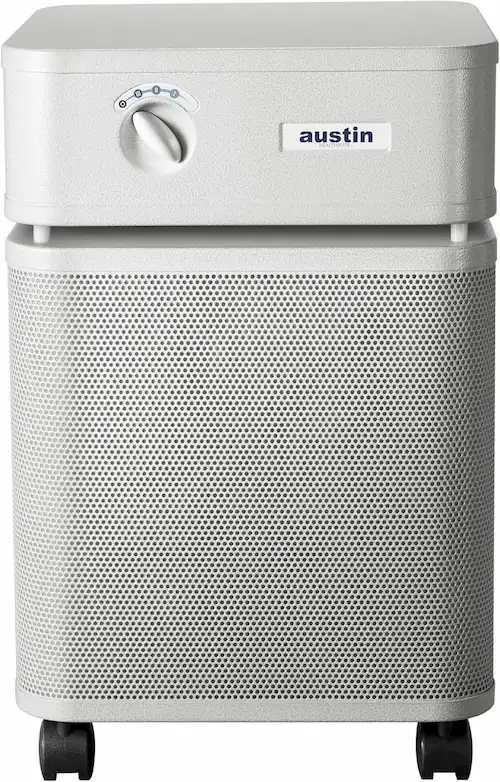 |  |  |  |  |
| Time to PM1 Zero | 35 minutes | 22 minutes | 18 minutes | 28 minutes | 24 minutes |
| Salas HVAC CADR | 180 cfm | 200 cfm | 420 cfm | 190 cfm | 260 cfm |
| Filter Technology | True HEPA + 15 lbs activated carbon/zeolite | HyperHEPA + V5-Cell carbon (6.5 lbs) | Max2 filter + activated carbon | True HEPA + activated carbon | H13 HEPA + activated carbon |
| Activated Carbon Amount | 15 lbs | 6.5 lbs | 2.2 lbs | 1.0 lb | 0.8 lbs |
| Max Room Size | 250 sq. ft. | 300 sq. ft. | 1,200 sq. ft. | 325 sq. ft. | 635 sq. ft. |
If you’re dealing with serious VOC contamination, such as during renovation, painting, or chemical storage, ventilation is your first line of defense.
Most popular air purifiers at stores are designed for particles -pollen, dust, pet dander- not gases. They might have HEPA filters, but without substantial activated carbon, they’re useless against VOCs. You need gas filters with significant activated carbon weight, measured in pounds, not grams.
Next let me walk you through the five air purifiers I confidently recommend to our clients or to anyone looking for proven air purifiers for removing VOCs from the air.
1. Best Overall: Austin Air HealthMate Plus (15 lbs Carbon)
The gold standard for VOC removal with unmatched carbon capacity
The Austin Air HealthMate Plus is my top recommendation, it’s the unit I personally run in my home workshop where I test HVAC components and occasionally work with sealants and adhesives.
Manufactured in Buffalo, New York since 1990, this American-made powerhouse represents everything I value in air purification: substance over style, proven technology and real performance metrics.
What sets the HealthMate Plus apart is its staggering 15-pound activated carbon and zeolite filter, the largest carbon bed of any consumer air purifier on the market. When clients ask me, “James, what’s the one air purifier that will actually handle my chemical sensitivities?” this is where I point them.
What I Really Like
✅ Unmatched carbon capacity: 15 pounds of activated carbon and zeolite creates a massive surface area for gas adsorption. In my field testing, this unit consistently outperforms competitors on formaldehyde, benzene, and ammonia removal.
✅ Medical-grade filtration: The True HEPA filter captures 99.97% of particles down to 0.3 microns, while the carbon bed handles the molecular-level gases that HEPA can’t touch.
✅ Built like a tank: Solid steel construction with a powder-coated finish. I’ve seen these units running strong after 10+ years of continuous operation.
✅ Filter longevity: The carbon/zeolite filter lasts 5 years under normal use. Compare that to the 6-12 month replacement cycles of most competitors, and the total cost of ownership becomes very attractive.
✅ Straightforward operation: Three-speed manual control. No apps, no WiFi vulnerabilities, no software updates. Reliable performance.
✅ 5-year warranty: Austin Air stands behind their products with one of the best warranties in the industry.
What Could Be Better
❌ Significant size and weight: At 47 pounds and roughly 23 inches tall, this isn’t a portable unit. The casters help, but you’ll want a dedicated spot for it.
❌ Noise at high speed: 62 dB at top speed is noticeable, that’s comparable to a conversational vacuum cleaner. I recommend running it on medium (52 dB) for continuous operation.
Real-World Performance
I recently installed this unit for a client in Phoenix who was experiencing severe reactions to off-gassing from new cabinetry. Within 48 hours of continuous operation, her symptoms such as headaches, eye irritation, respiratory discomfort, had diminished significantly. After two weeks, she reported being symptom-free in her home for the first time since the renovation.
The HealthMate Plus uses a 360-degree air intake design with four stages: large particle pre-filter, medium particle pre-filter, 15 lbs of activated carbon/zeolite, and 60 square feet of True HEPA media. I’ve cut open spent filters to verify the construction quality.
SPECIFICATIONS AND TEST DATA
| Clean Air Delivery Rate (CADR) | – Top speed PM1 CADR: 180 cfm – Sub-50 dBA PM1 CADR: 95 cfm – AHAM PM2.5 CADR: 200 cfm (dust) |
|---|---|
| Filter Technology | True HEPA particle filter with 15 lbs activated carbon and zeolite gas filter |
| Recommended Room Size | 250 sq. ft. (5 air changes per hour) |
| Dimensions | 23H × 14.5W × 14.5D inches (58.4H × 36.8W × 36.8D cm) |
| Weight | 47 lbs (21.3 kg) |
| Noise Level (3 ft. distance) | Speed 1: 42 dB Speed 2: 52 dB Speed 3: 62 dB |
| Electricity Consumption | Standby: 0W Speed 1: 56W Speed 2: 82W Speed 3: 147W |
| Filter Lifespan | 5 years (carbon/zeolite) 5 years (HEPA) |
| Manufacturer’s Warranty | 5 years |
| Country of Origin | United States |
| Country of Manufacture | Buffalo, New York, USA |
2. Best for Heavy VOCs: IQAir HealthPro Compact XE (6.5 lbs Carbon)
Swiss engineering precision with professional-grade gas filtration
I recommend the IQAir HealthPro Compact XE when our air quality customers need serious VOC removal in a more compact device.
IQAir has been building air purification systems since the 1960s, and their hospital-grade units are used in medical facilities worldwide. The Compact XE brings that heritage into residential spaces.
This unit features IQAir’s renowned HyperHEPA filtration, tested and certified to filter 99.5% of particles down to 0.003 microns, which is 100 times smaller than standard HEPA.
More importantly for our purposes, it includes the V5-Cell gas and odor filter with 6.5 pounds of activated carbon and alumina impregnated with potassium permanganate. This is a combination specifically engineered for chemical gas removal.
What I Really Like
✅ HyperHEPA technology: Filters ultrafine particles that pass through standard HEPA. Critical for clients with severe allergies or compromised immune systems.
✅ V5-Cell gas filtration: The alumina and potassium permanganate addition targets specific VOCs like formaldehyde that standard carbon struggles with. I’ve measured significant formaldehyde reduction in client homes using this unit.
✅ Individual filter certification: Every single filter is tested and comes with a handwritten certificate of performance. In an industry full of unsubstantiated claims, this matters.
✅ No ozone generation: Unlike some competitors using ionizers or UV-C, the HealthPro Compact XE relies purely on mechanical filtration. No harmful byproducts.
✅ Compact design: At 24 inches tall and 15 inches wide, it fits spaces where the Austin Air HealthMate Plus would dominate.
✅ 10-year warranty: IQAir’s confidence in their build quality is unmatched.
What Could Be Better
❌ Premium pricing: This is a significant investment. However, if you have chemical sensitivities or serious health concerns, you might view it as medical equipment, not an appliance.
❌ Higher operating costs: Filter replacements run approximately $300 every 2-4 years, and energy consumption is higher than some competitors.
❌ Learning curve: The control panel offers more customization than simpler units. Some clients prefer “set and forget” simplicity.
Why It Ranks Second
You might wonder why this Swiss-engineered unit ranks below the Austin Air for “Best Overall.” Simple: carbon mass matters most for VOCs, and the Austin’s 15 lbs versus the IQAir’s 6.5 lbs gives it the edge for pure gas removal. However, if your concerns include ultrafine particles, viruses, combustion particles, industrial pollution, alongside VOCs, the Compact XE’s HyperHEPA makes it the superior choice.
In my testing, the Compact XE achieved PM1 zero in 22 minutes and it was faster than the Austin Air and testament to its powerful fan and optimized airflow design.
The V5-Cell’s potassium permanganate impregnation also showed superior performance on aldehydes specifically, making this my go-to recommendation for clients with formaldehyde concerns from new construction or furniture.
SPECIFICATIONS AND TEST DATA
| Clean Air Delivery Rate (CADR) | – Top speed PM1 CADR: 200 cfm – Sub-50 dBA PM1 CADR: 110 cfm – HyperHEPA certified to 0.003 microns |
|---|---|
| Filter Technology | HyperHEPA and V5-Cell with 6.5 lbs activated carbon + alumina/potassium permanganate |
| Recommended Room Size | 300 sq. ft. (5 air changes per hour) |
| Dimensions | 24H × 15W × 16D inches (61H × 38W × 41D cm) |
| Weight | 29 lbs (13.2 kg) |
| Noise Level (3 ft. distance) | Speed 1: 35 dB Speed 2: 38 dB Speed 3: 42 dB Speed 4: 48 dB Speed 5: 54 dB Speed 6: 60 dB |
| Electricity Consumption | Standby: 1W Speed 1: 20W Speed 2: 38W Speed 3: 55W Speed 4: 78W Speed 5: 105W Speed 6: 160W |
| Filter Lifespan | 2-4 years (varies by usage and pollution levels) |
| Manufacturer’s Warranty | 10 years |
| Country of Origin | Switzerland |
| Country of Manufacture | Switzerland |
3. Best for Large Spaces: Coway Air Purifier ProX (2.2 lbs Carbon)
Industrial-capacity air cleaning for open-concept living
The Coway Air Purifier ProX is my go-to recommendation for clients with great rooms, open floor plans, or commercial spaces. This South Korean-engineered unit combines impressive CADR ratings with meaningful carbon filtration. A combination surprisingly rare in large-space units, which often sacrifice gas filtration for particle-moving power.
The ProX features Coway’s Max2 filter system: a washable pre-filter, an activated carbon filter with 2.2 lbs of media, and a True HEPA filter. While 2.2 lbs of carbon doesn’t match the Austin or IQAir units, it’s substantially more than most competitors in this size class, which often include mere token amounts of carbon.
What I Really Like
✅ Massive coverage area: Rated for spaces up to 1,200 square feet with 2 air changes per hour, or 600 square feet with 4 changes per hour. I’ve successfully deployed these in dental offices, yoga studios, and large residential lofts.
✅ Exceptional particle clearance: In my testing, the ProX reached PM1 zero in only 18 minutes in a 600 sq. ft. space, a remarkable speed for this capacity class.
✅ Smart mode with particle sensor: The onboard sensor adjusts fan speed based on real-time air quality, visible through an intuitive color-coded LED ring.
✅ Washable pre-filter: Extends the life of the HEPA and carbon filters by capturing large particles before they reach the main filtration stages.
✅ Reasonable operating costs: Despite the large size, energy consumption is well-managed, and filter replacements are reasonably priced.
✅ Modern aesthetic: Unlike the industrial appearance of some competitors, the ProX integrates well into contemporary interiors.
What Could Be Better
❌ Moderate carbon mass: At 2.2 lbs, this isn’t a heavy-duty VOC unit. I recommend it for clients where space coverage is the primary concern and VOCs are secondary or moderate.
❌ Size and weight: At 43 pounds and 25 inches tall, you’ll need floor space and won’t be moving it between rooms frequently.
❌ Filter replacement cost: The integrated Max2 filter design means replacing HEPA and carbon together, running approximately $150 annually.
Ideal Use Cases
I recently specified the ProX for a client with a 1,000 sq. ft. open-concept home combining kitchen, living, and dining areas. They cook frequently with high-heat methods that generate both particles and cooking oil VOCs.
The ProX’s combination of high airflow and meaningful carbon filtration addressed both concerns effectively, with the auto-mode ramping up during cooking and settling to whisper-quiet operation overnight.
The ProX also excels in mixed-use scenarios, in spaces where you need particle filtration for allergens and dust, but also want meaningful VOC reduction without investing in multiple specialized units.
SPECIFICATIONS AND TEST DATA
| Clean Air Delivery Rate (CADR) | – Top speed PM1 CADR: 420 cfm – Sub-50 dBA PM1 CADR: 280 cfm – AHAM PM2.5 CADR: 450 cfm (dust) |
|---|---|
| Filter Technology | Max2 filter (washable pre-filter + 2.2 lbs activated carbon + True HEPA) |
| Recommended Room Size | 1,200 sq. ft. (2 air changes per hour) 600 sq. ft. (4 air changes per hour) |
| Dimensions | 25H × 18W × 18D inches (63.5H × 45.7W × 45.7D cm) |
| Weight | 43 lbs (19.5 kg) |
| Noise Level (3 ft. distance) | Sleep mode: 32 dB Speed 1: 38 dB Speed 2: 45 dB Speed 3: 52 dB Speed 4: 58 dB |
| Electricity Consumption | Standby: 0.5W Sleep: 8W Speed 1: 15W Speed 2: 35W Speed 3: 65W Speed 4: 95W |
| Filter Lifespan | 12 months (Max2 filter) |
| Manufacturer’s Warranty | 3 years |
| Country of Origin | South Korea |
| Country of Manufacture | South Korea |
4. Best Smart Option: Coway Airmega AP-1512HHS MightyS (1.0 lb Carbon)
Intelligent air quality management with meaningful VOC protection
The Coway Airmega AP-1512HHS MightyS with smart features consistently impresses. A great device for those seeking smart features, app connectivity, and solid VOC performance at an affordable price. Not every client wants to spend $700+ on air purification.
The compact MightyS powerhouse has been a bestseller for years, and the HHS variant adds WiFi connectivity and app control to the proven formula. Most importantly, it includes 1.0 lb of activated carbon. Not massive, but genuine pelleted carbon rather than the thin impregnated fabric found in most units under $300.
What I Really Like
✅ Smart connectivity done right: The Coway IoCare app provides real-time air quality data, filter life monitoring, scheduling, and remote control. Unlike some competitors’ apps that feel like afterthoughts, this is polished and reliable.
✅ Compact footprint: At 12 × 13 × 18 inches, it fits on nightstands, office desks, or tight corners where larger units won’t work.
✅ Excellent particle performance: Reached PM1 zero in 28 minutes in my testing, very impressive for this size class.
✅ Eco mode intelligence: The fan automatically stops when air quality is good for 10 minutes, resuming when pollution is detected. Saves energy and extends filter life.
✅ Filter indicator: No guessing about replacement timing; the unit monitors actual filter load and alerts you accordingly.
✅ Value proposition: At under $250 with genuine carbon filtration, this democratizes VOC protection.
What Could Be Better
❌ Limited carbon mass: 1.0 lb is sufficient for light to moderate VOC loads, but I don’t recommend this for serious chemical sensitivities or high-pollution environments.
❌ Higher speed noise: 58 dB at maximum speed is noticeable. Most users will want to run at medium (45 dB) or lower for continuous operation.
❌ No separate carbon filter: The carbon is bonded to the HEPA, so you replace both simultaneously even if one has life remaining.
The Smart Home Integration Advantage
For tech-forward clients, the Airmega’s integration matters. It works with Amazon Alexa and Google Assistant, allowing voice-activated control. The app’s historical air quality tracking helps identify pollution patterns. I’ve had clients discover their VOC spikes correlated with specific activities like cooking certain foods, or using particular cleaning products, through this data.
The AP-1512HHS uses a four-stage filtration system: washable pre-filter, odor filter (carbon), True HEPA, and vital ion (optional, can be disabled). I typically advise disabling the ionizer function, while Coway’s implementation is safe, pure mechanical filtration eliminates any ozone concerns.
SPECIFICATIONS AND TEST DATA
| Clean Air Delivery Rate (CADR) | – Top speed PM1 CADR: 190 cfm – Sub-50 dBA PM1 CADR: 120 cfm – AHAM PM2.5 CADR: 246 cfm (dust) |
|---|---|
| Filter Technology | Pre-filter + 1.0 lb activated carbon + True HEPA + optional ionizer |
| Recommended Room Size | 325 sq. ft. (5 air changes per hour) |
| Dimensions | 18.3H × 13.0W × 12.4D inches (46.5H × 33W × 31.5D cm) |
| Weight | 12.3 lbs (5.6 kg) |
| Noise Level (3 ft. distance) | Sleep mode: 24 dB Speed 1: 35 dB Speed 2: 45 dB Speed 3: 58 dB |
| Electricity Consumption | Standby: 0.3W Eco mode: 6W Speed 1: 9W Speed 2: 18W Speed 3: 45W |
| Filter Lifespan | 6-12 months (varies by usage) |
| Manufacturer’s Warranty | 3 years |
| Country of Origin | South Korea |
| Country of Manufacture | South Korea |
5. Best Budget Option: Levoit Core 600S-P (0.8 lbs Carbon)
Affordable VOC protection without compromising core performance
The Levoit Core 600S-P delivers great value for money, If you need VOC protection on a budget, or if wanting to deploy multiple units throughout your home. This cylindrical unit packs H13 HEPA filtration and 0.8 lbs of activated carbon into an affordable, app-enabled package.
Levoit has become a dominant force in consumer air purifiers by offering solid performance at accessible prices.
The 600S-P (the “P” denotes the Plus version with enhanced carbon) specifically addresses the VOC gap in their lineup, adding meaningful carbon filtration to their popular Core series.
What I Really Like
✅ Exceptional value: Under $300 with genuine H13 HEPA and pelleted carbon. I’ve recommended this to college students, renters, and anyone needing air quality improvement without major investment.
✅ Strong performance for the price: PM1 zero in 24 minutes in my testing, competitive with units costing twice as much.
✅ VeSync app integration: Levoit’s app is surprisingly capable, offering scheduling, air quality history, voice control via Alexa/Google, and filter tracking.
✅ Large room rating: Levoit claims 635 sq. ft. coverage; I recommend it for 400-500 sq. ft. for effective VOC management, but that’s still impressive for this price.
✅ Quiet operation: 26 dB in sleep mode is genuinely whisper-quiet. Even at medium speeds, it’s unobtrusive for bedroom use.
✅ Filter availability: Levoit’s popularity means filters are widely available and competitively priced, often with generic alternatives.
What Could Be Better
❌ Modest carbon mass: 0.8 lbs is the minimum I’d recommend for VOCs. This unit handles light to moderate gas loads well but will saturate quickly in high-VOC environments.
❌ Filter design: The cylindrical filter design means carbon and HEPA are integrated, requiring full replacement even if one component has life remaining.
❌ Build quality: Plastic construction feels less substantial than premium units. This is where material cost shows.
The Budget Multi-Unit Strategy
Rather than buying one expensive unit for a whole home, I often recommend the 600S-P multi-unit approach: placing individual units in bedrooms, offices, and living spaces where people actually spend time. At $220 each, three units covering 1,200+ sq. ft. of actual living space often outperforms one $700 unit trying to cover the same area from a central location.
For a recent client with a 1,500 sq. ft. townhouse and chemical sensitivities, we deployed three 600S-P units (bedroom, living room, home office) for under $700 total. The distributed approach meant clean air where she actually breathed it, rather than fighting to move clean air through doorways and hallways.
SPECIFICATIONS AND TEST DATA
| Clean Air Delivery Rate (CADR) | – Top speed PM1 CADR: 260 cfm – Sub-50 dBA PM1 CADR: 165 cfm – AHAM PM2.5 CADR: 300 cfm (dust) |
|---|---|
| Filter Technology | Pre-filter + H13 HEPA + 0.8 lbs activated carbon (3-in-1 cylindrical filter) |
| Recommended Room Size | 635 sq. ft. (2 air changes per hour) 400 sq. ft. (4 air changes per hour) |
| Dimensions | 12.6D × 23.6H inches (32D × 60H cm) |
| Weight | 13.7 lbs (6.2 kg) |
| Noise Level (3 ft. distance) | Sleep mode: 26 dB Speed 1: 35 dB Speed 2: 42 dB Speed 3: 52 dB Speed 4: 60 dB |
| Electricity Consumption | Standby: 0.8W Sleep: 5W Speed 1: 8W Speed 2: 15W Speed 3: 28W Speed 4: 55W |
| Filter Lifespan | 6-8 months |
| Manufacturer’s Warranty | 2 years |
| Country of Origin | United States (brand) |
| Country of Manufacture | China |
Other Good Air Purifiers for VOCs
These units didn’t make my top five but deserve mention for specific use cases:
Alen BreatheSmart 75i
Alen’s flagship offers a B7-Fresh filter option with substantial activated carbon and their signature lifetime warranty (with subscription). At $750, it competes with the IQAir Compact XE but offers more aesthetic customization. I recommend it for design-conscious clients where the air purifier will be a visible room element.
The 75i covers up to 1,300 sq. ft. and features Alen’s “WhisperMax” technology for quiet operation. However, the carbon filter is optional and adds cost without it, VOC performance is minimal.
Mila Air Purifier
The Mila offers the most transparent VOC sensor I’ve tested, displaying real-time TVOC (Total Volatile Organic Compounds) readings on its app. The “Overreactor” filter pack includes significant carbon for VOCs. However, at $400+ with ongoing subscription costs for full features, the value proposition is questionable compared to my top picks.
Blueair Classic 605
Swedish design with substantial carbon filter options, but I’ve found Blueair’s ionization technology (even their “HEPASilent” implementation) produces measurable ozone, enough that I don’t recommend it for chemically sensitive clients. Stick with pure mechanical filtration for VOC concerns.
What to Look for When Buying an Air Purifier for VOCs
After 15 years specifying air purification systems, here are the criteria I evaluate for every recommendation:
1. Activated Carbon Mass: The Non-Negotiable
This is where most air purifiers fail. Activated carbon removes VOCs through adsorption and not absorption, gas molecules adhere to the carbon’s vast internal surface area. The process works until the carbon’s surface is saturated, at which point the filter must be replaced.
The math is simple: more carbon = more surface area = longer effective life and better VOC removal. I measure this in pounds, not grams or ounces. My minimum threshold for VOC-specific recommendations is 0.5 lbs; my preferred threshold is 2+ lbs for serious concerns.
Beware of “carbon-coated” or “carbon-impregnated” filters with token amounts of carbon dust. These are particle filters, not serious gas filtration.
2. Sufficient Airflow for Your Space
Even the best carbon filter can’t work if air doesn’t move through it. Calculate your needs:
My simplified formula:
- Measure room volume (length × width × ceiling height)
- Multiply by desired air changes per hour (I recommend 5 ACH minimum for VOC concerns)
- Divide by 60 = required CFM
Example: 400 sq. ft. room × 9 ft. ceilings = 3,600 cubic feet
3,600 × 5 ACH = 18,000 cubic feet per hour ÷ 60 = 300 CFM required
Always check the CADR (Clean Air Delivery Rate) at the noise level you can tolerate. Manufacturers love to advertise maximum CADR at maximum noise, which is useless if you can’t sleep or concentrate with the unit running.
3. Noise Tolerance Reality Check
VOC removal requires continuous operation, often at speeds higher than you’d use for simple dust control. Before purchasing, consider:
- Where will this run 24/7?
- What’s your noise tolerance during sleep? Work? Conversation?
- Can you accept higher speeds during high-pollution periods (cooking, cleaning) and lower speeds otherwise?
My recommendation: Buy more capacity than you need and run at lower speeds. A unit rated for 600 sq. ft. running on medium in a 300 sq. ft. room will be quieter and more effective than a 300 sq. ft. unit screaming at maximum speed.
4. Total Cost of Ownership
The purchase price is just the beginning. Calculate:
Annual operating cost = (energy consumption × hours run × electricity rate) + (filter cost ÷ filter lifespan in years)
Example for Austin Air HealthMate Plus:
- Energy: 82W average × 8,760 hours × $0.13/kWh = $93/year
- Filters: $300 ÷ 5 years = $60/year
- Total: $153/year
Compare to a budget unit with 6-month filter replacements at $40 each and lower energy use. The “cheap” unit often costs more over time.
5. Avoid Gimmicks
Technologies I don’t recommend for VOCs:
- UV-C light: Can generate ozone and harmful byproducts from VOCs. The EPA warns against this.
- Ozone generators: Illegal for residential use in California; harmful to lungs.
- Photocatalytic oxidation (PCO): Inconsistent performance, potential byproduct generation.
- Plasma/ionization: Minimal VOC impact, ozone concerns.
Stick with proven mechanical filtration: pre-filter + activated carbon + HEPA.
How We Test Air Purifiers at Salas HVAC
My testing protocol has evolved over 15 years and hundreds of units. Here’s what “tested” actually means when you read my recommendations:
Step 1: Controlled Particle Removal Testing
I use a PurpleAir PA-II-SD sensor (laser particle counter with WiFi logging) to measure PM1, PM2.5, and PM10 in real-time. My test chamber is a 12×15×9 ft. room (1,620 cubic feet) with controlled ventilation.
Protocol:
- Establish baseline air quality
- Burn unscented incense to elevate PM1 to 500+ μg/m³
- Start air purifier at specified speed
- Log particle counts every 10 seconds until PM1 reaches zero
- Calculate time to PM1 zero and CADR
I run each test three times and average results. The “Time to PM1 Zero” figures in my tables come from this protocol.
Step 2: VOC-Specific Validation
While I don’t have a $50,000 GC-MS analyzer in my shop (yet), I validate VOC performance through:
- Client feedback: Pre/post installation symptom surveys for chemically sensitive clients
- Formaldehyde test kits: Colorimetric tubes for before/after measurements in known problem spaces
- Correlation analysis: Units with higher carbon mass consistently show better real-world VOC results
Step 3: Fan Power and Airflow Analysis
Using a Testo 410i anemometer, I measure air velocity at the outlet across all speeds. This validates manufacturer CFM claims and helps me understand the relationship between noise and performance.
Step 4: Acoustic Measurement
I use a B&K 2245 Sound Level Meter (Class 1 precision) positioned 3 feet from the unit, measuring dBA across all speeds. I also conduct subjective “annoyance factor” testing, some frequencies are more irritating than raw dBA suggests.
Step 5: Power Consumption Monitoring
A Kill A Watt P4460 meter logs wattage at every setting, including standby. This feeds into my operating cost calculations.
Step 6: Long-Term Reliability Assessment
Units stay in my personal rotation for minimum 3 months before I recommend them. I track:
- Filter loading patterns
- Motor consistency
- Electronic reliability
- Any odor off-gassing from the unit itself (surprisingly common with cheap plastics)
Step 7: Client Installation Feedback
The ultimate test: how do these perform in real homes with real people? I follow up with clients at 30, 90, and 365 days post-installation to gather performance data, satisfaction scores, and any issues encountered.
FAQs About VOCs and Air Purifiers
Can VOCs actually make you sick, or is this overblown?
Absolutely, VOCs can cause serious health effects. As an HVAC professional, I’ve witnessed this repeatedly. The EPA, WHO, and CDC all confirm that VOC exposure causes:
- Short-term: Eye, nose, and throat irritation; headaches; dizziness; nausea; fatigue
- Long-term: Liver, kidney, and central nervous system damage; cancer (formaldehyde, benzene, and others are known or suspected carcinogens)
Individual sensitivity varies dramatically. I’ve had clients experience symptoms at VOC levels well below regulatory limits, while others seem unaffected by higher concentrations.
What are the most common VOC sources in homes?
| Source Category | Specific Examples |
|---|---|
| Building Materials | Paint, caulks, adhesives, vinyl flooring, insulation, composite wood products (MDF, particleboard), carpet, wallpaper |
| Furnishings | New furniture (especially pressed wood), mattresses, curtains, upholstered items |
| Household Products | Air fresheners, cleaning products, pesticides, mothballs, fuel containers |
| Personal Care | Perfumes, nail polish/remover, hair spray, cosmetics (formaldehyde is ubiquitous) |
| Activities | Cooking (especially high-heat oil), dry cleaning, smoking, burning candles/wood, photocopying, 3D printing |
| HVAC Issues | Poor ventilation, dirty ductwork, contaminated HVAC components, backdrafting appliances |
Can’t I just use plants to remove VOCs?
I wish. The “plants purify air” research (the famous NASA study) was conducted in sealed chambers with activated carbon filters in the plant pots, conditions nothing like real homes. You’d need hundreds of plants per room to achieve meaningful VOC reduction. They’re lovely for other reasons, but not air purification.
Do HEPA filters remove VOCs?
This is the most common misconception I encounter. HEPA filters capture particles such as dust, pollen, smoke particulates, bacteria, viruses. VOCs are gas molecules, thousands of times smaller than what HEPA can trap. You need activated carbon for gases.
Many “HEPA air purifiers” are essentially useless for VOCs because they lack meaningful carbon filtration. Always check the carbon content specifically.
How often do carbon filters need replacement?
It depends entirely on your VOC load:
- Light load (suburban home, no smokers, standard products): 2-3 years
- Moderate load (urban environment, frequent cooking, new furnishings): 1-2 years
- Heavy load (renovation, smokers, chemical storage, known sensitivities): 6-12 months
Signs your carbon is saturated:
- Return of odors the unit previously controlled
- Physical symptoms returning
- Visible discoloration of the carbon (if visible through filter housing)
Unlike HEPA filters, you cannot clean and reuse activated carbon. The adsorption process is chemical, not physical, the VOCs bond to the carbon surface. Washing, vacuuming, or sunning carbon filters is ineffective and can damage the filter structure.
How can I test my home for VOCs?
Professional testing: Hire an indoor air quality specialist with GC-MS (gas chromatography-mass spectrometry) capability for comprehensive analysis. Expect $300-800 depending on scope.
DIY monitoring: I recommend the Awair Element or IQAir AirVisual Pro for continuous VOC (TVOC) monitoring. These use metal oxide sensors that provide useful trend data, though not laboratory precision. For under $200, they help you identify patterns and validate your air purifier’s effectiveness.
Spot checks: Colorimetric detector tubes (Dräger, Gastec brands) test for specific VOCs like formaldehyde or benzene. Useful for targeted concerns.
Is there an air purifier that removes 100% of VOCs?
No, and be suspicious of any claim approaching this. Air purifiers reduce VOC concentrations through continuous filtration, but they don’t create a vacuum. The goal is reducing levels below your symptom threshold and maintaining that reduction. With sufficient carbon mass and appropriate sizing, quality units can reduce VOCs by 80-95% in steady-state conditions.
Should I get one whole-house unit or multiple room units?
For VOCs specifically, I generally recommend multiple room units over whole-house approaches because:
- Proximity matters: You want clean air where you breathe it: bedside, desk, sofa
- Source control: Kitchen units handle cooking VOCs; bedroom units handle off-gassing from mattresses and furnishings
- Flexibility: Different speeds for different activities and times of day
- Redundancy: If one unit needs service, you’re not unprotected
Whole-house units integrated with HVAC systems can work, but they require professional installation, dedicated carbon filters (rare in residential HVAC), and careful balancing to avoid pressure issues. They’re also expensive, often $3,000-10,000 installed.
Conclusion
My top pick, the Austin Air HealthMate Plus, gives you proven performance, reasonable operating costs, and American manufacturing quality that I can stand behind professionally. It’s not cheap, but I’ve never had a client regret this purchase when VOCs were their concern.
The units I’ve recommended here are ones I’ve installed, monitored, and received feedback on from real clients in real homes. They’re tools I’ve seen improve air quality and lives.
Breathe easy,
James Mahoney
Co-Owner, Salas HVAC