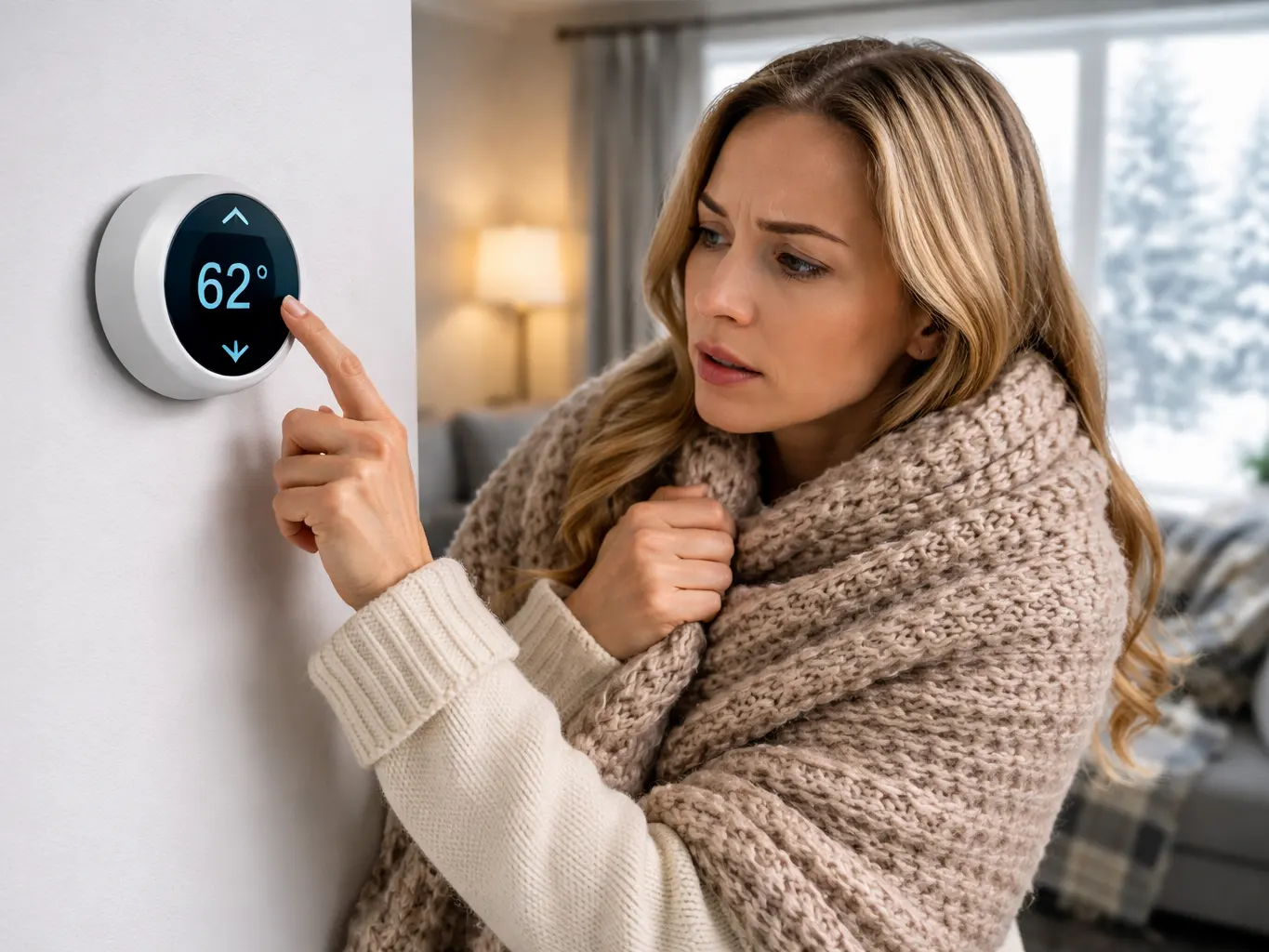
Your heater kicks on, you hear it running, but half your house still feels like the outdoors. That gap between what the thermostat says and what you actually feel is one of the most common complaints we handle here at Salas HVAC.
We have worked on heating systems across Scottsdale and Arizona homes for decades. The causes behind uneven heating come down to a short list of problems, and most of them are faster to diagnose than you think.
Why Isn’t My Furnace Heater Heating Every Room in My Home?
Your heating system does not push warm air equally to every room by chance. It relies on a network of ducts, vents, filters, and controls all working together.
When any single piece of that system fails or gets restricted, heat stops reaching certain areas of your home.
The good news is that most of these problems fall into seven common categories. Work through the list below and you will find the one that matches what is happening in your house.
1. Blocked or Obstructed Vents
This is the first thing to check because it takes less than two minutes. Walk through each room and look at the floor, wall, or ceiling vents.
Furniture, rugs, curtains, or even a stack of boxes can block airflow completely. When a vent sits behind a couch or under a heavy bookshelf, that room simply does not receive warm air.
Pull everything back from your vents and make sure each one is fully open. If you have adjustable registers, turn them so the damper is not restricting flow.
2. A Dirty or Clogged Air Filter
A clogged air filter is the single most common cause of reduced heating performance across the board. The filter sits inside your system and catches dust, pet dander, and debris before that air circulates through your home.
When the filter gets thick with buildup, your furnace or heat pump has to strain to push air through it. That strain means less warm air reaches rooms farther from the unit.
According to the U.S. Department of Energy, a clogged filter forces your HVAC system to use up to 15% more energy just to maintain normal output.
Check your filter every month. Replace it at least every 90 days, or more often if you have pets or live in a dusty area. If you are not sure which filter your system takes, pull the current one out and check the size printed on the frame.
You can read more about how filters work and where to find yours on our site: how to find and change your AC filter.
3. Thermostat Problems
Your thermostat tells your heating system when to turn on and what temperature to hold.
If it reads the wrong temperature or fails to send the signal, your heater may run without actually warming the whole house.
Three things to check right now:
- Check the setting. Make sure the thermostat is set to “Heat” and not “Cool.” This sounds obvious, but it happens more often than you would expect, especially after a season change.
- Replace the batteries. Most battery-operated thermostats need fresh batteries once a year. A dying battery sends weak or inconsistent signals to your system.
- Check the location. If your thermostat sits near a drafty window, a sunny spot, or a heat source like a lamp, it reads the wrong temperature. That causes your system to shut off too soon or run too long in the wrong direction.
If none of those fixes solve the problem, the thermostat itself may need replacement. We handle thermostat installation and setup as part of our controls and thermostat services.
4. Leaky or Poorly Sealed Ductwork
This is a cause that most articles gloss over, but it is a major one — especially in older homes. Your ductwork is the highway that carries warm air from your furnace or heat pump to every room.
When ducts develop cracks, loose joints, or gaps, heated air escapes before it reaches the rooms you care about.
The U.S. Department of Energy reports that in a typical house, 20 to 30 percent of the air moving through the duct system is lost due to leaks, holes, and poorly connected sections.
ENERGY STAR notes that sealing and insulating ducts can improve heating and cooling efficiency by as much as 20 percent.
Here are the warning signs of a leaky duct system:
- Rooms far from the furnace stay noticeably colder than rooms near it
- Your heating bill keeps climbing even though nothing else has changed
- You can feel warm air blowing from seams or joints in exposed duct runs
- Ducts run through your attic, garage, or crawlspace without insulation
Do not use regular duct tape to seal these leaks. It dries out and fails within months.
A qualified HVAC tech will use mastic sealant or foil-backed tape, and may run a duct leakage test to find problems you cannot see.
5. Short Cycling
Short cycling means your heater turns on, runs for a few minutes, and shuts off before your home reaches the set temperature. Then it starts again. And again.
This on-and-off pattern does two things.
First, it prevents your home from heating evenly because each cycle is too short to push warm air to distant rooms.
Second, it puts heavy wear on the system every time the motor starts and stops.
Common causes of short cycling include:
- An oversized furnace. A unit too large for your home heats the area around the thermostat too fast, triggering an early shutoff. The rest of the house stays cold.
- A tripped high-limit switch. This safety device shuts the furnace down if the heat exchanger gets too hot, usually because of restricted airflow from a dirty filter or blocked vents.
- A failing heat exchanger. Once cracks develop in the heat exchanger, the furnace shuts off to prevent carbon monoxide from entering your living space.
If your heater short cycles regularly, stop running it until a technician takes a look. A cracked heat exchanger is a safety issue, not just a comfort one.
6. Damaged Zone Controls
If your home uses a zoned heating system, different areas get their own thermostat or control damper. Each zone heats independently based on what that zone’s thermostat requests.
When zone controls fail, one area might get all the heat while another stays cold. The dampers that open and close inside your ductwork can stick, get stuck in the wrong position, or lose their connection to the zone controller board.
Symptoms of a zone control problem include:
- One section of your home is significantly warmer or colder than the rest
- A zone thermostat shows the right temperature setting, but the area does not heat up
- You hear the furnace running, but no air comes out of vents in a specific zone
Zone control repairs require someone who understands the wiring and control board. This is not a job to tackle on your own.
A technician needs to test each damper, verify the wiring, and confirm the controller is sending the right signals.
7. Skipped or Overdue Maintenance
Think of your heating system like any other mechanical equipment. It needs regular attention to keep performing the way it was designed to.
When you skip annual maintenance, several things start to go wrong at once:
- Buildup on the heat exchanger reduces how efficiently your system transfers heat to the air
- Worn belts or bearings slow down the blower, cutting airflow to your rooms
- Dirty burners produce less heat per cycle, meaning your system runs longer to hit the target temperature
- Small problems compound into bigger, more expensive repairs down the road
We recommend scheduling a furnace maintenance visit once a year, ideally before the colder months hit. A full tune-up catches issues early and keeps your system running at the output it was rated for.
If you have a heat pump instead of a gas furnace, the same rule applies. Annual heat pump maintenance keeps your system running at full capacity through every season.
8. Your Heater Is Past Its Prime
Every heating system has a finite lifespan. Once it passes that window, performance drops off noticeably and unevenly.
Signs Your Furnace Needs Replacement
According to ASHRAE (the American Society of Heating, Refrigerating and Air-Conditioning Engineers), the median service life of a gas or oil-fired furnace is 18 years.
The U.S. Department of Energy uses a similar range of 15 to 20 years in its efficiency standards modeling.
If your furnace is approaching or past that range, watch for these signs:
- Uneven heating across your home that gets worse each winter
- Repair calls happening more than once or twice a year
- Energy bills rising while your system output stays flat or drops
- Loud banging, rattling, or humming that was not there before
An aging furnace does not fail all at once. It gradually loses the ability to move heat where it needs to go. At a certain point, repairs cost more than a well-sized replacement unit would over the next several years.
If you are on the fence about repair versus replacement, we can walk you through the numbers with no pressure. Check out our furnace replacement options or give us a call.
FAQs
Why is one room in my house always colder than the others?
The most common reasons are a blocked vent, a dirty air filter restricting airflow, or leaky ductwork that drops heated air before it reaches that room. Check your vent for obstructions and your filter for buildup first. If those are both clear, you likely have a duct or zoning issue that needs professional diagnosis.
How often should I change my furnace filter?
Every 90 days at minimum, or monthly if you have pets, allergies, or a dusty environment. ENERGY STAR recommends checking it every month and replacing it whenever it looks dirty, regardless of the schedule.
How long does a furnace last before it needs replacement?
ASHRAE lists the median lifespan of a gas or oil-fired furnace at 18 years. With proper annual maintenance, some units run well past 20 years. Without maintenance, performance degrades much sooner.
Can I fix uneven heating myself?
Some causes are straightforward DIY fixes, clearing blocked vents, replacing a filter, or adjusting thermostat settings. Anything involving ductwork, zone controls, or the furnace itself should be handled by a licensed technician.
Why does my heater run but not heat my house?
If the system fires up but warm air never reaches your rooms, the likely culprits are a clogged filter, leaky ductwork, or a failing heat exchanger. A heat exchanger issue is a safety concern, so stop running the unit and call a certified HVAC company.
If your heater is not doing its job, contact us for a diagnostic visit.
Stay warm, stay comfortable,
Michael
Sources:
- ASHRAE Equipment Life Expectancy Chart. American Society of Heating, Refrigerating and Air-Conditioning Engineers. ashrae.org.
https://www.naturalhandyman.com/iip/infhvac/ASHRAE_Chart_HVAC_Life_Expectancy.pdf - EGIA. “Average Service Life of Residential HVAC Equipment.” Contractor University Library, 2025.
https://library.mycontractoruniversity.com/wp-content/uploads/2025/10/EGIA-AverageServiceLife.pdf - ENERGY STAR. “Heat & Cool Efficiently.” U.S. Environmental Protection Agency, 2024. https://www.energystar.gov/saveathome/heating-cooling
- U.S. Department of Energy. “Minimizing Energy Losses in Ducts.” Office of Energy Efficiency and Renewable Energy, 2024.
https://www.energy.gov/energysaver/minimizing-energy-losses-ducts - University of Florida Institute of Food and Agricultural Sciences. “Energy Efficient Homes: The Duct System.” FCS3263/FY1024.
https://edis.ifas.ufl.edu/publication/FY1024